
India Demonstrates Strategic Capability with Fighter Aircraft Landing on Assam Highway
In a significant display of strategic preparedness and infrastructure integration, India successfully conducted a fighter aircraft landing on a specially developed highway stretch in Assam, underlining its enhanced defence capabilities and message of deterrence in the eastern sector.
The development marks a new chapter in the history of defence and disaster management infrastructure in Northeast India. Prime Minister Narendra Modi inaugurated the region’s first Emergency Landing Facility (ELF) in Assam’s Dibrugarh district. The facility has been constructed on a section of National Highway-37 near Moran and is designed to function as an airstrip during emergencies.
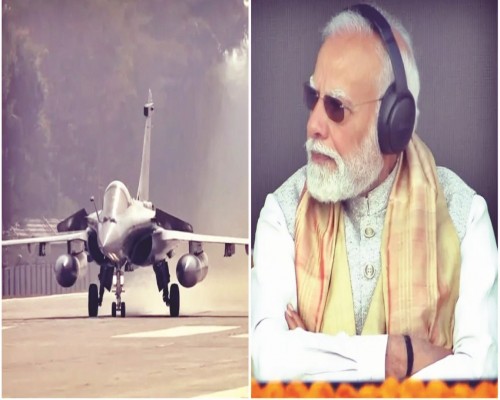
Following the inauguration, the Prime Minister travelled aboard an Indian Air Force C-130J Super Hercules aircraft and landed on the specially designed highway stretch, creating a historic moment in India’s civil-military infrastructure coordination. The landing demonstrated that the highway can serve as an operational runway during wartime contingencies, natural disasters, or other emergency situations.
The Emergency Landing Facility has been developed at an estimated cost of approximately ₹100 crore. The 4.2-kilometre stretch on the Moran bypass has been specially engineered in coordination with the Indian Air Force to accommodate fighter aircraft and heavy transport planes. The reinforced infrastructure is capable of handling aircraft weighing up to 40 tonnes, and in certain configurations, transport aircraft of up to 74 tonnes.
The strategic importance of this initiative is considerable. Located in proximity to sensitive border areas, the facility strengthens India’s rapid deployment capability in the Northeast and enhances operational readiness. By integrating highways into defence infrastructure planning, India has showcased its ability to convert civilian infrastructure into strategic assets when required.
The event also included an aerial display by the Indian Air Force, highlighting India’s air power. Advanced fighter aircraft such as the Sukhoi-30 MKI and Rafale jets performed manoeuvres during a 20-minute air show, underscoring technological sophistication and operational capability. The display reinforced the broader message of preparedness and deterrence.
The initiative forms part of a wider push to enhance infrastructure in the Northeast region. Alongside the inauguration of the Emergency Landing Facility, multiple development projects worth over ₹5,450 crore were unveiled. Among them was the inauguration of the 2.86-kilometre-long Bhupen Hazarika Setu (also known as the Dhola-Sadiya Bridge) over the Brahmaputra River, built at a cost of approximately ₹3,030 crore. The bridge strengthens connectivity between upper Assam and Arunachal Pradesh, significantly improving regional logistics and mobility.
Additionally, projects related to data infrastructure and educational facilities were announced, including initiatives aimed at strengthening digital connectivity and regional development.
Addressing a public gathering in Guwahati, Prime Minister Modi criticized previous governments for neglecting the Northeast and alleged that policies driven by vote-bank considerations had hampered development and security in the region. He asserted that the current administration has prioritized infrastructure, security, and inclusive growth to integrate the Northeast more closely with the national mainstream.
The dual focus on defence readiness and regional development highlights a comprehensive strategy—one that combines military preparedness with economic expansion and connectivity. The highway-based airstrip reflects a broader doctrine of resilience, where infrastructure serves both civilian and strategic purposes.
Experts view the Assam highway landing as a strong signal of India’s preparedness in the eastern theatre. By enabling fighter aircraft operations from highways, India joins a select group of nations that maintain such dual-use infrastructure capabilities. The move enhances flexibility during conflict scenarios and strengthens response mechanisms in times of natural disasters or humanitarian emergencies.
Overall, the successful landing and associated infrastructure projects underline India’s intent to fortify the Northeast as both a strategic and developmental frontier, reinforcing national security while accelerating regional growth.