
Noida Workers’ Protest Puts India’s New Labour Codes to Their First Major Test
The recent workers’ protest in Noida’s industrial belt has brought India’s new labour regime into sharp public focus. What began as a wage-related agitation in one of the country’s most important manufacturing clusters soon became a larger debate on minimum wages, regional wage disparity, industrial peace, social security and the practical implementation of the four Labour Codes.
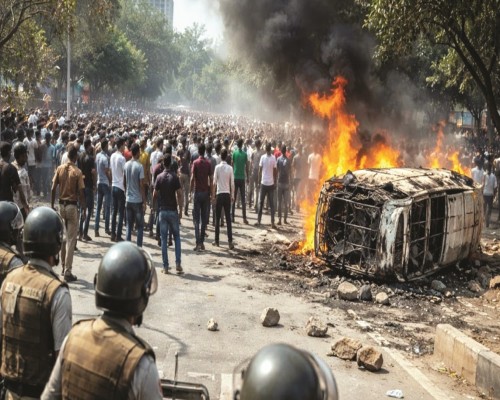
The protest gained national attention after thousands of workers in Noida demanded higher wages and parity with workers in neighbouring Haryana, particularly Gurugram and Manesar. According to reports, nearly 40,000 workers participated in the agitation, which was linked to demands for better wages after Haryana announced a major increase in minimum wages. The protest later turned violent in parts of Noida, with incidents of stone-pelting, vandalism and arson being reported, following which police action and arrests took place. Reuters reported that more than 300 people were arrested and seven criminal cases were registered after the unrest.
The central issue behind the agitation was the wage gap within the National Capital Region. Although Noida and Gurugram fall in different states, they are part of the same economic geography. Workers, contractors, vendors and industrial supply chains often move across Delhi, Haryana and Uttar Pradesh. Many workers living in the same region perform similar work for factories located barely a few kilometres apart, yet their legally notified wages differ because minimum wages are fixed by different state governments. This difference became more visible after Haryana reportedly increased minimum wages by nearly 35%, while workers in Noida demanded similar treatment.
In response to the unrest, the Uttar Pradesh government announced an interim increase in minimum wages with effect from April 1, 2026. For Noida and Ghaziabad, the increase was reported to be around 21%. According to reports, the minimum monthly wage for unskilled workers in these areas was increased from ₹11,313 to ₹13,690, while semi-skilled workers’ wages rose from ₹12,445 to ₹15,059 and skilled workers’ wages from ₹13,940 to ₹16,668. The government also clarified that the increase was not a uniform ₹20,000 minimum wage, as some social media claims had suggested.
The Noida episode has therefore become a practical test for the new Labour Codes, which came into effect from 21 November 2025. The Government of India has stated that the four Labour Codes consolidate 29 existing labour laws into four broad frameworks: the Code on Wages, 2019; the Industrial Relations Code, 2020; the Code on Social Security, 2020; and the Occupational Safety, Health and Working Conditions Code, 2020. The stated purpose of these reforms is to simplify compliance, strengthen worker welfare and create a more modern labour regulatory system.
However, the Noida protest shows that legal consolidation alone cannot resolve ground-level labour tensions unless implementation is timely, clear and uniform. The Code on Wages seeks to bring greater consistency in wage-related matters and introduces the concept of a national floor wage. Yet actual minimum wages continue to be notified by states, keeping alive the possibility of regional wage differences. In a tightly connected labour market such as NCR, this creates a sensitive situation where workers compare wages not only with other factories but also with neighbouring states.
For industry, the protest has raised important concerns about operational continuity, compliance planning and labour communication. Noida is home to electronics, garment, automobile component, engineering and export-oriented units. Any disruption in such a region can affect production schedules, supply chains and investor confidence. SamvardhanaMotherson International, whose name appeared in media coverage of the unrest, clarified that the protests had no material impact on its operations and described the unrest as part of a broader labour issue affecting multiple industries, linked to misinformation around wage revisions.
At the same time, the protest cannot be viewed only as a law-and-order issue. It reflects the pressure of rising living costs on industrial workers, especially in urban and semi-urban manufacturing belts. Workers in NCR face expenses related to rent, food, transport, education and healthcare. When wage revisions are delayed or when there is a sharp difference between nearby industrial regions, dissatisfaction can quickly spread. The Indian Express reported that workers protesting in Noida referred to Haryana’s wage revision and demanded similar wages for similar work.
The administration has also begun responding institutionally. Following the unrest, the Gautam Budh Nagar police commissionerate reportedly created a dedicated industrial cell and temporarily appointed a Deputy Commissioner of Police for industrial affairs. The purpose of this step is to improve coordination between police, industries and workers, and to prevent future industrial disputes from escalating into street unrest.
The larger lesson is that labour reform requires both legal clarity and social dialogue. Employers must understand that compliance under the new Labour Codes is not merely a paperwork exercise. Wage structure, overtime payment, working hours, social security, health and safety, appointment letters and grievance redressal are now central to industrial stability. Similarly, workers’ concerns must be addressed through lawful negotiation, transparent communication and timely government intervention, rather than allowing resentment to grow unchecked.
The Noida workers’ protest has also underlined the need for employers to communicate wage revisions clearly. Misinformation regarding wage hikes, eligibility, effective dates and arrears can create confusion among workers. HR departments and factory managements must ensure that every employee understands the notified wage rates, the difference between minimum wages and gross salary, the basis of statutory deductions and the company’s compliance position. In the absence of such communication, rumours can become stronger than official notifications.
For the government, the challenge is to create a balanced framework where workers receive fair wages and social security while industries remain competitive. Sudden wage shocks can affect cost structures, especially for MSMEs and labour-intensive industries. At the same time, prolonged wage stagnation can lead to unrest, absenteeism, low productivity and poor industrial relations. The objective must be a predictable wage revision mechanism that is legally sound, economically practical and socially acceptable.
The Noida protest should therefore be treated as a warning as well as an opportunity. It is a warning that industrial peace cannot be taken for granted in regions where wage disparity and cost-of-living pressures are rising. It is also an opportunity to implement the new Labour Codes in their true spirit: fair wages for workers, simplified compliance for employers, stronger social security and constructive coordination between government, industry and labour.
India’s new labour framework has now moved from legislative reform to real-world testing. The Noida unrest shows that the success of the Labour Codes will depend not only on what is written in the law, but on how effectively governments notify rules, how responsibly employers comply, and how fairly workers’ grievances are heard. For a manufacturing economy aspiring to become globally competitive, industrial harmony is not optional. It is the foundation on which productivity, investment and inclusive growth must stand.