
A Gift Rooted in Spiritual Legacy — PM Modi Receives Sacred Daruma Doll in Japan
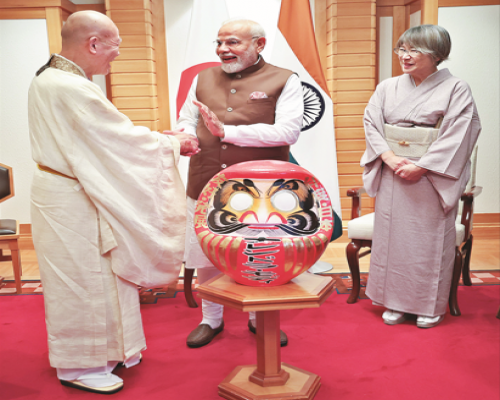
In a highly symbolic and culturally rich gesture, Prime Minister Narendra Modi was presented with a traditional Daruma doll by Rev. Seishi Hirose, the chief priest of the Shorinzan Daruma-Ji Temple in Takasaki, Gunma Prefecture. This exchange underscored the profound spiritual heritage shared between India and Japan.
The Daruma Doll: Tradition, Symbolism, and Resilience
The Daruma doll, crafted from papier-mâché, is instantly recognizable thanks to its round, hollow form—typically painted in vibrant red—and the unique way it rights itself when tipped over. This attribute symbolizes the Japanese proverb “Nanakorobiyaoki” (“fall down seven times, stand up eight”), embodying the spirit of resilience and perseverance.
One of the most striking features of the Daruma is its initially blank white eyes. Upon receiving the doll, one eye is filled in when setting a goal, while the other is painted only after the goal is achieved—turning the doll into a living talisman of dedication and success.
An Indian Legacy—Bodhidharma’s Journey
The Daruma doll finds its spiritual inspiration in Bodhidharma, a revered 5th-century monk originally from Kancheepuram, India—known in Japan as Daruma Daishi. His legendary nine-year meditation—reportedly withered limbs from immobility—is symbolized in the doll’s armless, legless design.
Takasaki, the birthplace of these iconic dolls and home to the Shorinzan Daruma Temple, continues to celebrate this heritage through annual festivals that draw thousands to honor traditions of good fortune and renewal.
Cultural Diplomacy Embodied
The Prime Minister’s Office described the gift as a symbol of resilience, spiritual connection, and the deep civilizational bonds between India and Japan. The Daruma was not just a souvenir—it was a meaningful nod to shared philosophical traditions and enduring goodwill.
Summary Table
|
Aspect |
Significance |
|
Design |
Round, hollow, self-righting—embodies perseverance and adaptability. |
|
Eyes |
Painted sequentially to represent goal-setting and achievement. |
|
Origin |
Inspired by Bodhidharma, an Indian monk whose spiritual legacy connects India and Japan. |
|
Gift Significance |
A diplomatic symbol reinforcing spiritual affinity and cooperative spirit between nations. |