
Allahabad High Court Calls for Mandatory Audio-Video Recording of Witness Statements During Investigation
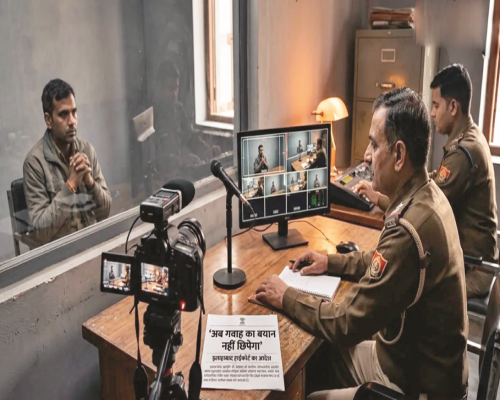
The Allahabad High Court has emphasised that audio-video recording of witness statements should be made mandatory during criminal investigations, observing that such a system can improve transparency, strengthen impartiality and assist courts in dealing more effectively with bail and other judicial proceedings.
A Single Bench of Justice Arun Kumar Singh Deshwal, while considering a bail application, issued a set of directions for police authorities aimed at improving the quality and reliability of investigation.
The Court observed that in serious offences carrying a punishment of 10 years or more, witness statements should ordinarily be recorded before a magistrate under the relevant legal provisions. It also stressed the importance of using digital methods for preserving statements and evidence.
Key Directions Issued for Investigation
The High Court laid down several measures to strengthen investigative procedures. It directed that once information regarding a cognisable offence is received, the investigating officer should promptly visit the scene and record statements of the first informant and witnesses without unnecessary delay.
The Court said that electronic evidence should be properly preserved and audio-video recordings should be made wherever required. Statements of independent witnesses, and not merely those of the complainant, should also be recorded to ensure a more balanced investigation.
In cases involving serious offences, the Court indicated that witness statements should be recorded before a magistrate under the appropriate statutory provision.
For cases involving allegations linked to obscene or objectionable videos, the Court said mobile devices should be seized, sent for forensic examination where necessary, and assistance from cyber experts should be taken.
The Court also said that where the location of an accused person is relevant and digital or conversational data is available, investigators should obtain the necessary electronic records. Searches and recoveries should be conducted in accordance with the statutory procedure governing search and seizure.
Concern Over Absence of Audio-Video Recording
The Court examined a case registered under different provisions of the Bharatiya Nyaya Sanhita (BNS) along with provisions of the Dowry Prohibition Act. During the hearing, the Court noted that a statement had been recorded under the relevant criminal procedure provision but no audio-video recording had been made.
The High Court questioned investigating officers on this issue and observed that when the law contemplates audio-video recording of statements, there is no justification for routinely avoiding such a process.
The Court noted that in several matters, investigating officers appear reluctant to make audio-video recordings because of concerns that recorded statements could later be compared with other versions and discrepancies might become evident.
Recording Can Improve Reliability of Criminal Investigation
The High Court observed that digital recording of witness statements can reduce disputes over whether statements were properly recorded and whether they were subsequently altered or reproduced inaccurately.
Such recordings can also assist courts in assessing the credibility of material placed before them, particularly in bail matters and other proceedings where the contents and manner of recording witness statements can become significant.
The Court also examined the case of an accused woman who had remained in custody since May 18, 2026, and found that there was insufficient material to establish a strong prima facie case of abetment to suicide under the relevant provisions.
The ruling reinforces the growing judicial emphasis on technology-based investigation, preservation of electronic evidence and transparent recording of witness statements, with the broader objective of improving fairness and accountability in the criminal justice process.