
Empowering MSMEs: National Workshop Emphasizes Cost Competitiveness, Technology, and Policy Reforms
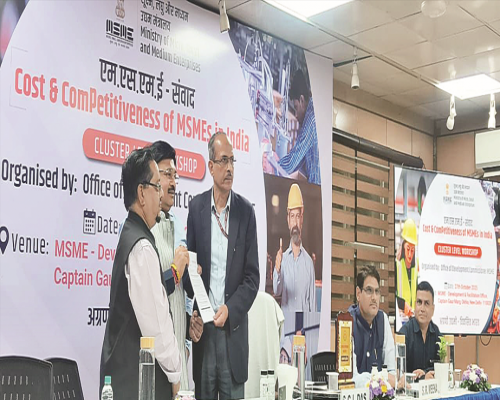
A Cluster Level Workshop on “Cost and Competitiveness of MSMEs in India”, organised by the Office of Development Commissioner (MSME), Ministry of MSME, Government of India, brought together prominent policymakers, industry leaders, and entrepreneurs to discuss the way forward for strengthening the Micro, Small and Medium Enterprises sector — the backbone of India’s industrial and employment ecosystem.
Representing the Indian Industries Association (IIA), Mr. Rajeev Bansal, National Vice President, IIA, actively participated in the deliberations and addressed the gathering in the presence of Shri S.C.L. Das, IAS, Secretary, Ministry of MSME, Government of India. His participation added valuable insights from the perspective of grassroots industries and entrepreneurs across India.
Key Issues Raised and Recommendations
1. Rising Production Costs:
Mr. Bansal emphasized that MSMEs are under growing pressure due to rising input costs, transportation expenses, and high energy tariffs. He proposed the establishment of Cluster-level Common Facility Centres (CFCs) to reduce operational costs and improve productivity.
2. Delayed Payments:
Despite legal provisions under the MSMED Act, delayed payments from large corporations and government departments continue to hamper working capital cycles. Mr. Bansal strongly advocated for strict enforcement of the 45-day payment rule to ensure timely liquidity for MSMEs.
3. Access to Finance:
The session highlighted the need for easier access to credit and financial schemes. Mr. Bansal suggested expanding awareness of CGTMSE and SIDBI initiatives, simplifying IPO procedures for SMEs, and enforcing mandatory registration of large corporates (with turnover above ₹250 crores) on the TReDS platform for facilitating affordable invoice financing.
4. Technology Upgradation:
A significant proportion of MSMEs still operate with outdated technologies. It was proposed that the government strengthen financial support schemes for modernization, digital adoption, and automation, enabling MSMEs to stay competitive in an evolving market.
5. Export Marketing and Global Competitiveness:
Mr. Bansal raised concerns over compliance costs, currency volatility, and procedural delays affecting MSME exporters. He urged the reinstatement of the Interest Subvention Scheme and the Market Development Assistance (MDA) and Market Access Initiative (MAI) programs. He also recommended setting up government-supported e-commerce platforms, foreign warehouses for exporters, and providing subsidies on essential export certifications to enhance India’s global trade competitiveness.
6. Skill Development and Design Support:
To strengthen product quality and innovation, it was suggested that industry-oriented training programs and design intervention schemes be made easily accessible at the cluster level to upskill the MSME workforce.
7. Availability of Industrial Land:
Mr. Bansal also highlighted that the exorbitant cost of industrial land, especially in NCR regions, is a major deterrent for MSME expansion. He proposed that the government explore affordable land allocation models and establish dedicated industrial parks for small and medium enterprises.
Collaborative Outcome
The workshop proved to be a constructive platform for industry-government dialogue, offering policy-level insights to enhance the productivity and resilience of MSMEs. The Ministry of MSME acknowledged the challenges raised and expressed its intent to integrate these recommendations into upcoming initiatives and reforms aligned with the vision of “Viksit Bharat – Leading
Entrepreneurs for a Developed India.”
Through the proactive representation of Mr. Rajeev Bansal, National Vice President, IIA, the voice of India’s MSME community was effectively articulated, reinforcing the need for a collaborative and reform-oriented approach toward making Indian enterprises globally competitive.