
Madhubani: The Art of Mithila
Madhubani: The Art of Mithila
In the northern reaches of Bihar, where the Ganges river meanders through the fertile plains of Mithila, an ancient artistic tradition continues to bloom in the hands of generations of women. Madhubani painting—sometimes simply called Mithila painting—is more than decoration: it is a language of devotion, folklore, and identity.
The word Madhubani translates to “forest of honey,” but to those who practice it, it is also a forest of stories. Rich in mythological motifs, spiritual symbolism, and the rhythms of everyday life, Madhubani art is among India’s most celebrated folk traditions, recognized worldwide for its striking lines and luminous colors.
Ancient Roots and Ritual Origins
The origins of Madhubani painting are steeped in legend. One of the most popular stories traces it back to the wedding of Sita and Rama, recounted in the epic Ramayana. According to local lore, King Janaka of Mithila commissioned artists to decorate the walls and courtyards with intricate murals to celebrate his daughter Sita’s marriage.
Whatever its precise beginnings, there is no doubt that for centuries, this art form has been an integral part of domestic and ritual life in Mithila. Traditionally, women painted directly onto freshly plastered mud walls and floors, marking important occasions—births, marriages, festivals, and religious ceremonies.
These murals were never made simply to beautify homes; they were offerings to the gods, auspicious blessings for the family, and records of communal memory.
Themes and Iconography
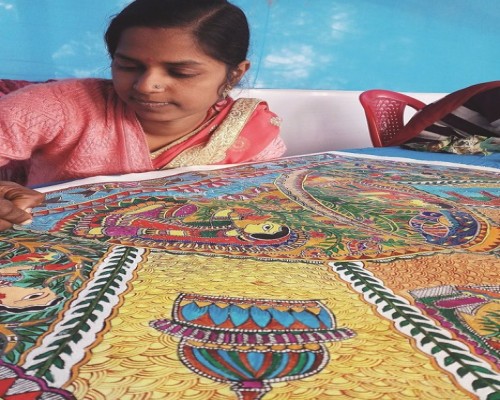
Madhubani art is defined by its vibrant and densely patterned imagery. The subject matter is drawn from a vast well of Hindu mythology and local folklore. Popular themes include:
- The divine love of Radha and Krishna
- Episodes from the Ramayana and Mahabharata
- Hindu deities—Durga, Shiva, Lakshmi, Saraswati, and Ganesha
- The sun and the moon as cosmic witnesses to human life
- Flora and fauna—lotuses, peacocks, fish, elephants
Symbolism infuses every detail. The fish stands for fertility and prosperity; the bamboo tree signifies growth and resilience; the lotus represents purity and spiritual awakening.
But Madhubani is not restricted to sacred themes. Over time, artists have incorporated scenes of village life—women drawing water, farmers ploughing fields, or newlyweds in procession—creating a tapestry of daily existence.
Distinctive Styles and Techniques
One of the most remarkable features of Madhubani painting is its stylistic diversity. Over time, five main styles evolved within the tradition:
- Bharni – Known for filled-in, brightly colored figures, often depicting gods and goddesses.
- Katchni – Characterized by delicate line work and cross-hatching instead of solid fills.
- Tantrik – Focusing on ritual symbolism and esoteric imagery, such as yantras.
- Godna – Inspired by tattoo patterns, using monochrome black or limited color palettes.
- Kohbar – Associated with marriage ceremonies, depicting lotus motifs, bamboo groves, and the union of male and female principles.
Traditionally, artists used natural materials. Brushes were crafted from twigs and cotton wrapped around a stick. Colors came from locally available plants and minerals:
- Black – from soot and cow dung
- Yellow – from turmeric
- Red – from kusum flowers or red clay
- Green – from leaves
- Blue – from indigo
A key feature is the absence of empty space. Artists fill gaps with patterns—vines, dots, or geometric borders—creating a sense of rhythmic completeness.
From Walls to Paper: A Modern Revival
Until the mid-20th century, Madhubani paintings existed exclusively on walls and floors. This changed dramatically in 1966, when a severe drought devastated the Mithila region. In a bid to provide alternative livelihoods, the All India Handicrafts Board encouraged women to transfer their art onto paper for sale.
This innovation sparked a transformation. For the first time, Madhubani paintings traveled beyond village homes—finding markets in India and abroad. Recognition followed quickly, with exhibitions, awards, and the attention of scholars and collectors.
Several pioneering artists, such as Sita Devi, Ganga Devi, Mahasundari Devi, and Baua Devi, rose to prominence, bringing their personal styles and stories to international audiences. Today, their works are held in museums including the National Museum in New Delhi and the Mithila Museum in Japan.
Madhubani in Contemporary India
In recent decades, Madhubani has evolved yet again. While traditional themes remain, artists are also using the form to address contemporary issues—environmental conservation, women’s empowerment, public health.
For example, during the COVID-19 pandemic, many Mithila artists painted gods wearing masks and healthcare workers as divine protectors, blending tradition with present-day concerns.
Young women from the region, equipped with digital tools and entrepreneurial training, are creating collectives, launching online stores, and collaborating with designers to bring Madhubani motifs into fashion, home décor, and illustration.
Yet, for all these innovations, the heart of the art remains unchanged: a celebration of life, a form of devotion, and an assertion of cultural pride.
Challenges and Preservation
Despite its popularity, Madhubani artists face challenges. The flood of cheap machine-printed imitations threatens their livelihoods. Many still lack access to fair markets and struggle for recognition and remuneration. There is also the delicate question of how to adapt tradition without eroding its essence.
Efforts are underway to support this heritage. NGOs and government bodies conduct training workshops, ensure GI (Geographical Indication) protection, and facilitate artisan cooperatives. Scholars and art historians document the stories of master painters to preserve their knowledge.
A Living Heritage
More than just a decorative art, Madhubani is a living heritage—one that connects past and present, the sacred and the everyday. Every painting is a testament to the resilience, creativity, and spirituality of the women of Mithila.
In a world that often rushes toward the new, Madhubani offers something timeless: the conviction that beauty is woven into the fabric of daily life, and that every line and color is a thread in the larger tapestry of culture.
Next time you stand before a Madhubani painting, take a moment to look closely. You’ll see not only gods and goddesses but the hands of countless women who, across centuries, have kept their stories alive—brush in hand, hearts full of devotion.