
Supreme Court Signals That the Time Has Come to Consider a Uniform Civil Code
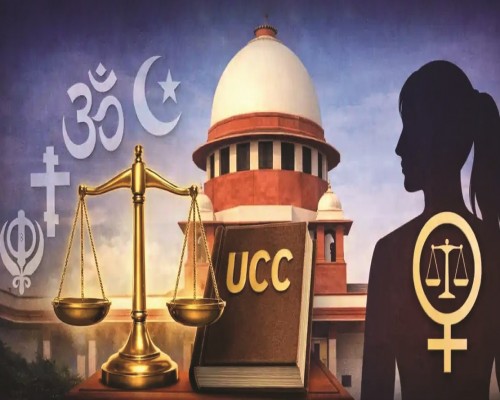
The Supreme Court has made significant observations indicating that the country may now be at a stage where the implementation of a Uniform Civil Code (UCC) deserves serious consideration, particularly in the context of gender justice and equal rights under personal laws.
The remarks came during the hearing of a petition seeking the striking down of certain provisions of the Shariat law framework, with the petitioner arguing that some existing personal law practices continue to discriminate against Muslim women and deny them equal constitutional protection.
During the proceedings, the bench observed that the issue raises broader constitutional and social questions and asked whether the time had arrived for the country to move toward a common legal framework governing civil matters such as marriage, divorce, inheritance and family rights. The court’s comments have once again brought the long-debated issue of a Uniform Civil Code into the national spotlight.
At the center of the matter was the argument that different personal laws often result in unequal treatment, especially for women. The petitioner contended that certain provisions under traditional personal law structures are inconsistent with constitutional guarantees of equality, dignity and non-discrimination.
The court reportedly questioned whether maintaining separate civil frameworks for different communities continues to be justified in a modern constitutional democracy, particularly when such distinctions may affect women’s rights and legal remedies.
One of the key concerns raised during the hearing was the issue of polygamy, especially the legal permissibility of one man having multiple wives under certain personal law interpretations. The matter was presented as an example of legal inequality that directly impacts the rights and dignity of women.
The bench is understood to have examined whether practices that allow differential treatment on the basis of religion or gender can withstand constitutional scrutiny in present times. It also reflected on whether the judiciary can or should test such practices against the broader framework of constitutional morality and fundamental rights.
The hearing also revived discussion around the landmark Narasu Appa Mali judgment, a long-standing legal precedent often cited in debates concerning the extent to which personal laws can be challenged under the Constitution. That judgment has historically influenced how courts approach the constitutional validity of personal law provisions.
The observations made by the court do not amount to a final ruling in favour of a Uniform Civil Code, but they are being viewed as a significant judicial signal that the conversation around legal uniformity, equality and reform is gaining renewed constitutional relevance.
The debate over the UCC has remained one of the most sensitive and consequential legal and political issues in India. Supporters argue that it would ensure equality before the law for all citizens, especially women, regardless of religion. Critics, however, maintain that any such move must be approached with sensitivity, broad consultation and respect for cultural and religious diversity.
The court’s remarks are likely to reignite wider public and legal debate on whether India’s personal law system should continue in its present form or evolve toward a more uniform civil framework grounded in constitutional values.
At its core, the matter is not merely about legal uniformity, but about balancing religious freedom, constitutional rights, gender justice and social reform—an issue that continues to shape the future of Indian jurisprudence and democratic discourse.