
The Gaganyaan Selection India’s Human Spaceflight Dream
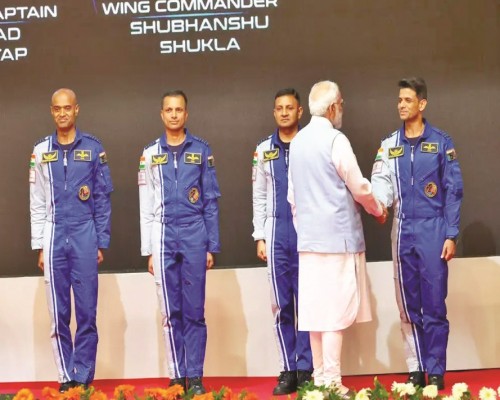
For decades after Rakesh Sharma’s historic 1984 flight, India aspired to return its citizens to space. But the resources and infrastructure required were staggering. It was only in 2018 that the dream began to crystallize, when Prime Minister Narendra Modi formally announced the Gaganyaan mission, aimed at launching an Indian crew aboard an indigenous spacecraft by 2025.
ISRO began collaborating with the Indian Air Force to identify and train the first Indian astronaut corps in more than a generation. In 2019, a nationwide selection process commenced. Hundreds of pilots and engineers applied. Only four were ultimately chosen.
Shubhanshu was one of them.
Training in Russia
In early 2020, Shubhanshu and his fellow selectees traveled to the Yuri Gagarin Cosmonaut Training Center in Star City, Russia. For more than a year, they underwent some of the most intense preparation imaginable. They studied spacecraft systems, orbital mechanics, and survival techniques. They endured centrifuge rides simulating 8-G acceleration and spent hours in isolation chambers to test their psychological resilience.
“Space doesn’t just test your body,” Shubhanshu later explained. “It tests your mind, your patience, your ability to adapt when nothing goes as planned.”
In parallel, he completed an M.Tech in Aerospace Engineering from the Indian Institute of Science in Bangalore—a testament to his commitment to understanding not just the how of spaceflight, but the why.
The Axiom Mission 4
A Bridge to Gaganyaan
While Gaganyaan prepared for its uncrewed test flights, ISRO sought opportunities to gain real-time experience with human space operations. Enter Axiom Space—a US-based private company specializing in commercial missions to the ISS. In 2024, an agreement was reached for Shubhanshu to join Axiom Mission 4, alongside retired NASA astronaut Peggy Whitson, Turkish Air Force pilot Alper Gezeravcı, and Italian biomedical engineer Walter Villadei.
This mission was more than a symbolic gesture. It was an opportunity for an Indian pilot to gain exposure to long-duration microgravity operations, life-support systems, and international mission protocols—skills that would be indispensable for Gaganyaan.
Launch Day
On June 25, 2025, Shubhanshu strapped into his seat aboard Dragon Grace, launched atop SpaceX’s Falcon 9 rocket from Kennedy Space Center. For a man who had flown dozens of high-performance aircraft, the experience was nonetheless overwhelming.
“The acceleration was familiar,” he recounted in an ISS video call. “But the realization that you’re leaving Earth behind—that’s something you can never fully prepare for.”
Life on the ISS
A Routine of Science and Symbolism
Once docked, Shubhanshu and his crewmates embarked on an 18-day mission that blended rigorous scientific research with public outreach. The Indian payloads he carried included experiments in material science, biomedicine, and plant growth in microgravity. Each day began at 6:00 AM GMT with systems checks and experiment briefings, followed by hours of lab work.
But it wasn’t all business. On July 4, he led a live demonstration of yoga in zero gravity, delighting audiences back home. On July 8, he spoke via ham radio to students across India, answering questions about space hygiene and psychological well-being.
He also carried with him mementos—a small figurine of Saraswati, the goddess of knowledge, and a tri-color flag, which he unfurled during a video call with Prime Minister Modi.
The Return and Reflections
Homecoming
On July 14, 2025, Dragon Grace undocked from the ISS. After a 22-hour journey, the spacecraft splashed down off the California coast at 3:00 PM IST on July 15. The recovery ship retrieved the capsule within minutes.
When the hatch opened, Shubhanshu emerged smiling, the Indian flag patch on his suit visible to the world. He had spent nearly three weeks in space, becoming the 634th human to do so—and only the second Indian.
In Lucknow, his parents watched live. His mother wept openly. “He has fulfilled his dream—and ours,” she said.
A Legacy in Motion
Today, Shubhanshu is more than a pilot or astronaut. He is a living symbol of India’s aspirations—to be not just a participant but a leader in the space age.