
Strong Manufacturing Base Helps India Negotiate Trade Agreements with Confidence, Says Prime Minister Narendra Modi
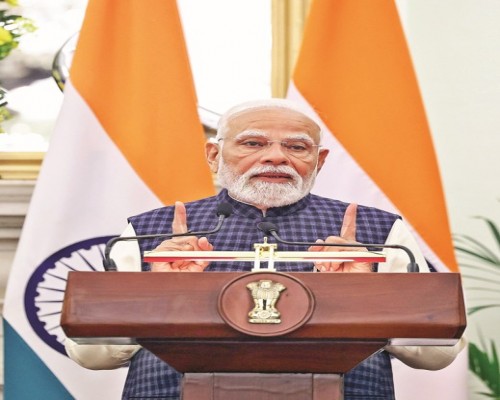
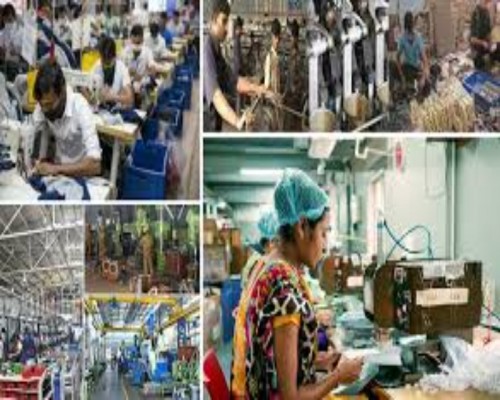
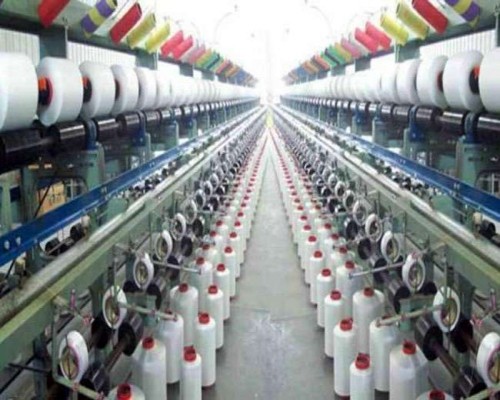
Prime Minister Narendra Modi has said that India’s growing strength in manufacturing, services, and the MSME sector has enabled the country to negotiate international trade agreements with greater confidence and strategic clarity. Emphasizing the importance of economic resilience, he stated that India’s improved industrial capacity and political stability have strengthened global investor confidence and expanded the country’s influence in international trade discussions.
Addressing issues related to ongoing free trade agreement (FTA) negotiations, the Prime Minister highlighted that India’s economic reforms and policy consistency have created a foundation for deeper engagement with global markets. According to him, the ability to negotiate trade deals with confidence is the result of sustained efforts to strengthen domestic industry and create a reliable business environment.
The Prime Minister noted that trade agreements represent an important milestone in India’s journey toward becoming a developed economy. He emphasized that the private sector must now move forward with greater determination and innovation to fully utilize the opportunities created through international trade partnerships.
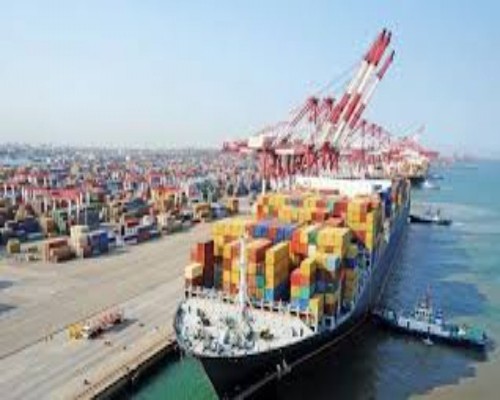
India has recently intensified its efforts to expand trade cooperation with multiple regions. Discussions on free trade agreements have involved several countries and economic blocs, including groups of developed economies. According to the Prime Minister, these agreements are designed not only to increase exports but also to integrate Indian industries into global supply chains.
He also highlighted the role of political stability and policy predictability in restoring investor confidence in India. Stable governance and clear economic priorities, he said, have helped create a favorable climate for both domestic and international investments.
Referring to earlier challenges in trade negotiations, the Prime Minister observed that in previous years several trade discussions often began but failed to reach meaningful conclusions. In contrast, recent negotiations have produced concrete outcomes, with India finalizing or advancing multiple trade agreements with partner countries.
According to government data, India has concluded trade agreements with dozens of countries over the past few years, creating broader market access for Indian goods and services. These agreements are expected to play a crucial role in boosting exports, strengthening industrial competitiveness, and attracting foreign investment.
The Prime Minister also pointed to the importance of structural reforms carried out by the government. Measures aimed at improving ease of doing business, modernizing infrastructure, and strengthening governance systems have helped create a more efficient economic ecosystem. He stated that these reforms are already delivering benefits to businesses and citizens.
Looking ahead, the Prime Minister emphasized three long-term priorities that will guide India’s development over the coming decades: institutional reforms, promoting innovation, and simplifying governance. These priorities, he said, will help sustain economic growth and position India as a major global economic power.
He further noted that India’s progress toward becoming a developed nation by 2047 will depend on how effectively Indian companies invest in innovation, build long-term capabilities, and compete at the global level. Encouraging industry leaders to take bold steps, he stressed that technological advancement and competitiveness will play a decisive role in shaping India’s future.
The Prime Minister also underlined the importance of responsible economic management. He stated that public spending must focus on productive investments rather than short-term populist measures. According to him, recent budgets have avoided excessive populist announcements and instead prioritized infrastructure development, job creation, and long-term economic stability.
He added that responsible governance and fiscal discipline are essential to ensuring sustainable growth. By focusing on infrastructure expansion, industrial development, and global trade integration, India aims to create a strong foundation for economic progress in the decades ahead.
The Prime Minister concluded by reiterating that India’s economic transformation will be driven by innovation, entrepreneurship, and global competitiveness. As the country deepens its engagement with international markets, stronger manufacturing capabilities and a dynamic private sector will remain central to India’s growth strategy.