

Goldfish Drives Tiny Car, Sets Unusual World Record
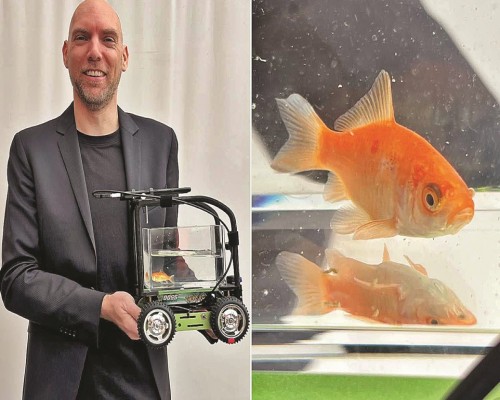
In an unusual blend of creativity, engineering and animal behavior research, a Netherlands-based engineer has drawn global attention after designing a miniature car for his pet goldfish and demonstrating that the fish could guide the vehicle’s movement.
The experimental vehicle was created by engineer Thomas de Wolf, who developed the small car specifically for his pet goldfish. What made the project remarkable was its unconventional “driver” arrangement: instead of a human-controlled steering system, the vehicle was designed around a water-filled tank placed where the driver’s seat would normally be. The goldfish remained inside the tank while the car responded to its movements.
The mechanism worked through a carefully designed sensor-based system. As the goldfish swam and shifted position inside the tank, the technology interpreted those movements and translated them into directional commands. This allowed the fish to effectively control the motion of the car and move it around in a limited test environment.
According to reports, the goldfish-driven car managed to travel 40 feet in one minute, covering a distance of approximately 3.46 inches per second, and in doing so established a world record of its kind. The feat quickly captured public imagination due to its novelty and the surprising level of control demonstrated by the aquatic “driver.”
Thomas de Wolf reportedly said that his pet goldfish appeared to respond in a manner similar to a small pet animal such as a puppy, inspiring him to undertake the amusing yet technically ambitious experiment. While the project may appear humorous on the surface, it also reflects a deeper exploration into adaptive design and motion-control technology.
Though a goldfish driving a car may not have practical everyday utility, the concept behind the project carries important implications. The technology used in the experiment could potentially contribute to the development of assistive mobility solutions for people with physical disabilities or limited movement. Sensor-based directional systems of this kind may, in the future, help individuals operate wheelchairs, mobility devices, or even customized vehicles with greater ease and independence.
What began as a playful and entertaining innovation has therefore sparked broader conversations about how imaginative engineering can sometimes lead to meaningful real-world applications. The project stands as an example of how curiosity-driven experimentation can push the boundaries of design, technology and accessibility in unexpected ways.