

Mars Plays a Crucial Role in Regulating Earth’s Long-Term Climate Cycles, Study Finds
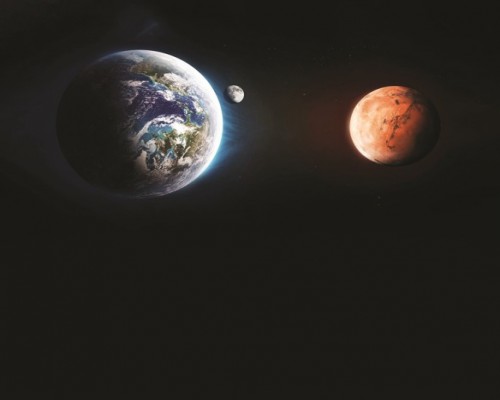
A recent scientific study has suggested that Mars, located millions of kilometres away from Earth, may play a significant role in influencing long-term climate cycles on our planet. Researchers have found evidence that variations in Mars’ orbit and gravitational interactions could be linked to changes in Earth’s deep-ocean circulation patterns and extended climate cycles spanning millions of years.
According to the study, Earth experiences long-term climate cycles lasting approximately 2.4 million years. Scientists have now proposed that these cycles are closely associated with subtle gravitational effects caused by Mars. The findings challenge the long-held belief that only Earth’s own orbital variations, along with gravitational influences from Jupiter and Saturn, were responsible for shaping such extended climatic patterns.
The research indicates that Mars’ gravitational pull may influence the stability of Earth’s orbital path over vast geological timescales. This interaction, in turn, appears to affect ocean currents and deep-sea sedimentation processes, both of which are closely linked to global climate regulation.
Scientists analyzed geological records, including deep-sea sediment cores, to trace historical climate variations. These records revealed recurring patterns consistent with a 2.4-million-year cycle. By correlating these patterns with astronomical data, researchers concluded that Mars’ orbital movements could be contributing to periodic shifts in Earth’s climate system.
The study further suggests that when Mars’ orbit changes, it can alter gravitational interactions within the solar system, subtly influencing Earth’s axial tilt and orbital shape. Such changes impact the distribution of solar radiation received by Earth, thereby affecting long-term climatic trends.
Researchers emphasized that while Mars does not directly cause immediate climate changes, its gravitational influence appears to play a role in shaping deep-time climate rhythms. The findings add a new dimension to the understanding of planetary interactions and their impact on Earth’s environment.
The study underscores the interconnected nature of celestial bodies within the solar system and highlights how even distant planetary movements can have measurable effects on Earth’s long-term climate stability. Scientists believe that continued research in planetary dynamics and geological records will further refine the understanding of these complex interactions.