
100 Years of RSS: Legacy, Transformation, and the Road Ahead
A Century of Influence
In 2025, as the saffron flag rises once again over Nagpur’s Reshimbagh grounds, the Rashtriya Swayamsevak Sangh (RSS) marks its centenary — a milestone few organisations in independent India can claim. Founded in 1925 by Dr. Keshav Baliram Hedgewar, the RSS began as a small movement dedicated to national rejuvenation through discipline, character-building, and a unified Hindu identity. A hundred years later, it has evolved into the world’s largest volunteer-based organisation, shaping India’s socio-political and cultural landscape in ways both celebrated and contested.
The Vision of Dr. Hedgewar
When Hedgewar founded the RSS in colonial India, his intent was neither political nor sectarian. He envisioned a moral and cultural awakening that would rebuild Indian society from within. The early shakhas — small community gatherings of swayamsevaks — were designed to instil discipline, physical fitness, and a spirit of service. Hedgewar believed India’s freedom struggle would be incomplete without social unity rooted in cultural pride.
This emphasis on personal transformation over political protest laid the foundation for what the Sangh would later describe as “man-making for nation-building.”
The Golwalkar Era and Institutional Expansion
After Hedgewar’s death in 1940, M.S. Golwalkar, affectionately known as “Guruji,” took over as the second Sarsanghchalak. He infused the RSS with an ideological structure centered on Hindutva — not as a religion, but as a civilisational identity that binds India together. Under Golwalkar, the organisation grew in scale and discipline, spreading its network of shakhas across provinces and developing a cadre-based system that would become its enduring strength.
Despite facing bans after Mahatma Gandhi’s assassination in 1948 and again during the Emergency of 1975, the RSS used adversity to consolidate its internal structure. Each ban made it more resilient, more organised, and more deeply rooted in civil society.
The Birth of the Sangh Parivar
By the 1950s, the RSS realised that its ideology could not remain confined to cultural mobilisation. Political expression became inevitable. The Bharatiya Jana Sangh — and later the Bharatiya Janata Party (BJP) — emerged as political offshoots of the RSS ideology.
Simultaneously, the organisation fostered a vast network of affiliates, known collectively as the Sangh Parivar. These included Vidya Bharati in education, Bharatiya Mazdoor Sangh in labour, Seva Bharati in social welfare, and Vishwa Hindu Parishad in religious affairs. Through these verticals, the RSS extended its influence across almost every segment of Indian life — from rural villages to corporate corridors.
Service, Society, and the Post-Emergency Resurgence
The late 20th century marked a phase of rapid growth. The RSS gained visibility through its extensive relief work during natural calamities, health camps, rural education initiatives, and campaigns promoting social harmony. By the 1980s, it had firmly established itself as a moral and social force that transcended politics — even as its ideological partner, the BJP, rose on the national stage.
The demolition of the Babri Masjid in 1992 brought both fame and infamy to the RSS. Supporters saw it as an assertion of cultural identity; critics viewed it as a symptom of majoritarian nationalism. Yet, the Sangh endured, adapting its language to the changing socio-political environment while remaining steadfast to its founding ideals.
From Margins to Mainstream
The early 21st century witnessed an extraordinary transformation. With the BJP’s ascent to power in 2014 under Narendra Modi — himself a former RSS pracharak — the organisation’s influence on national policy and cultural discourse reached new heights.
From campaigns promoting Swachh Bharat and Atmanirbhar Bharat to its push for character education and rural empowerment, the RSS’s themes of discipline, self-reliance, and national pride found echo in government narratives. Its affiliates flourished in education, environment, youth mobilisation, and indigenous entrepreneurship.
As of its centenary year, the RSS claims over 68,000 daily shakhas and millions of swayamsevaks. It operates through thousands of schools, social service institutions, and volunteer units — a civil society machinery unparalleled in scope.
The Centenary Celebrations: Legacy Meets Vision
In 2025, the organisation launched a nationwide campaign themed “100 Years of Sangh Yatra – New Horizons.” Yearlong programmes include mass Hindu Sammelans, door-to-door outreach drives, and specialised training camps across states.
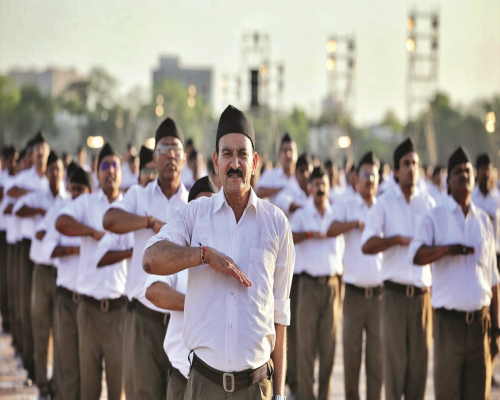
The celebrations culminate on Vijayadashami at Nagpur — where thousands of swayamsevaks perform synchronised drills, yoga, and shastra poojan rituals in homage to Dr. Hedgewar’s original vision. Speeches by current Sarsanghchalak Dr. Mohan Bhagwat highlight the central message: to build a disciplined, self-reliant, and united Bharat that upholds India’s cultural ethos while engaging with global modernity.
Ideology and Interpretation
At its core, the RSS defines its mission as character-building and nation-building. The guiding principle — “Seva hi Sangh ka Dharma hai” — emphasises service as a sacred duty. The organisation insists that Hindutva is not about exclusion but about recognising India’s civilisational roots as the moral foundation for national unity.
However, its detractors continue to challenge this narrative. Critics argue that the RSS promotes majoritarianism and blurs the line between religion and nationalism. Supporters, on the other hand, claim that it has successfully revived cultural confidence among Indians long alienated from their heritage.
Challenges in the Modern Era
At 100, the RSS faces new tests that Hedgewar could never have imagined. India’s rapidly urbanising, digital, and youthful society poses a challenge to traditional shakha-based mobilisation. Engaging Gen Z volunteers, maintaining ideological discipline in a media-saturated world, and addressing global perceptions of Hindutva will require significant adaptation.
Internally, the organisation acknowledges regional disparities — its presence remains weaker in parts of the Northeast, southern states, and among non-Hindu communities. Externally, balancing proximity to political power while preserving its claim of non-political identity continues to be a tightrope act.
Strengths and Enduring Relevance
Despite these challenges, few can deny the extraordinary organisational success of the RSS. Its decentralised yet cohesive structure, strong volunteer ethos, and ability to mobilise millions for civic causes make it one of the most disciplined institutions in modern India.
Its work in disaster relief, education, and rural development continues to attract admiration, even from critics. More importantly, it provides a sense of belonging and purpose to millions who see the Sangh not just as an organisation but as a lifelong way of service.
The Road Ahead: RSS Beyond 2025
The next quarter-century will define the RSS’s legacy more than its first hundred years. The centenary leadership has outlined a roadmap that includes deeper rural integration, global engagement with the Hindu diaspora, expansion of women’s participation, and greater intellectual outreach through publications and think tanks.
There is also a noticeable shift towards environmental and social causes — a recognition that the idea of Bharat Mata now extends beyond faith to include sustainability and equity.
As Mohan Bhagwat said during the centenary address, “Our goal is not to dominate, but to unite — to make Bharat strong, compassionate, and self-reliant.”