

AI Agents May Equal Human Workforce in Future, Says TCS Chairman
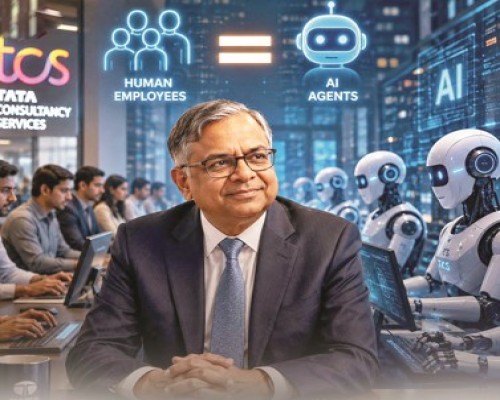
Artificial intelligence agents may become as numerous as human employees in the workforce of the future, according to Tata Consultancy Services Chairman N. Chandrasekaran. Speaking at the company’s annual general meeting, he said that AI agents are expected to work alongside employees and could significantly reshape the operating model of information technology companies.
Chandrasekaran said the future workforce may not consist only of human employees. Instead, human workers and artificial intelligence agents are likely to work together in large numbers. He indicated that if a company has five lakh employees, it may not be far from the time when it also has five lakh AI agents supporting different functions.
The statement comes at a time when the global information technology sector is closely watching the rapid rise of artificial intelligence and automation. Companies across the world are studying how AI can improve productivity, reduce repetitive work, support decision-making and transform service delivery models.
Addressing concerns over employment, Chandrasekaran said TCS is not preparing any plan to reduce its workforce. However, he acknowledged that new hiring may slow down in the future as the nature of work changes. According to the report, TCS had reduced more than 12,000 jobs in July last year, but the company has now maintained that it is not planning a further reduction in employee strength.
He said AI agents will not simply replace employees but will work with them. The future, according to him, will involve a combined workforce in which human talent and AI systems perform tasks together. This model may help companies handle larger volumes of work, improve speed and deliver services more efficiently.
The use of AI agents is expected to affect several areas of the IT industry. Routine tasks such as data processing, coding support, testing, documentation, customer support, monitoring, reporting and basic analysis may increasingly become automated. As a result, employees may be required to focus more on complex problem-solving, client strategy, innovation, supervision of AI systems and high-value advisory work.
The report states that India’s information technology sector, worth around $315 billion, is facing growing concern among investors. The concern is that AI may change the traditional business model of IT services companies, which has historically depended on a large number of employees deployed across client projects.
Chandrasekaran said the increased use of AI agents could reduce the number of people required for certain jobs across TCS and the wider IT sector. This would happen because some work currently performed by humans may become automated. However, the overall impact will depend on how companies redesign their processes, train employees and integrate AI into business operations.
The development also comes amid pressure on IT stocks. In 2026 so far, TCS shares have reportedly declined by more than 32 percent, while the Nifty IT index has fallen by nearly 25 percent. These figures reflect investor concerns about demand, profitability, automation and the future employment structure of the IT industry.
Despite these challenges, the growing use of artificial intelligence also presents major opportunities. AI agents can help IT companies improve productivity, offer faster solutions to clients and expand into new technology-led services. Companies that adapt quickly may be able to create new business models, while those dependent only on traditional manpower-based billing may face greater pressure.
The rise of AI agents is also expected to change the skills required in the technology industry. Employees may need to learn how to work with AI tools, manage automated systems, verify AI-generated outputs, protect data security and build solutions that combine human judgment with machine intelligence.
Industry experts believe that the coming years will be crucial for Indian IT companies. The sector may move from a model based mainly on the number of employees to one based more on productivity, automation, platforms and specialised digital solutions. This transition may also affect recruitment, training, project pricing and career paths.
TCS Chairman’s remarks underline a broader transformation taking place in the technology services industry. Artificial intelligence is no longer being seen only as a support tool but as a working digital agent that can perform defined tasks. As these systems become more advanced, their role in business operations is expected to expand further.
The key challenge for IT companies will be to balance automation with employment, efficiency with skill development, and cost reduction with innovation. For employees, the message is equally clear: the future workplace will require continuous learning and the ability to work effectively with AI-based systems.
The possibility of AI agents becoming equal in number to human workers signals a major shift in the structure of the modern workforce. While the change may create uncertainty, it may also open new opportunities for employees who are prepared to upgrade their skills and take on higher-value roles in an AI-enabled economy.