
BJP Announces New Ghaziabad Metropolitan Committee as Organisational Expansion Gains Momentum
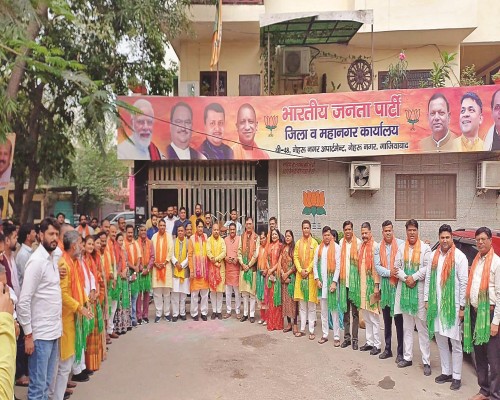
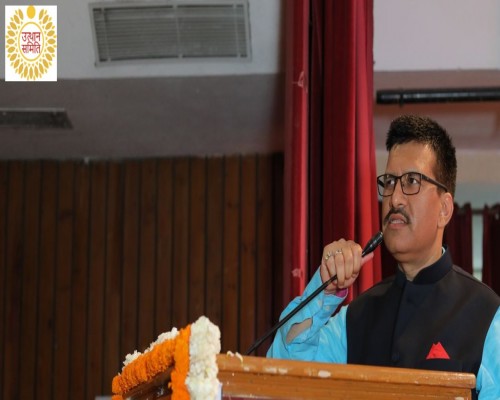
In a significant organisational move aimed at strengthening its political structure at the city level, the Bharatiya Janata Party (BJP) has announced its new Ghaziabad Metropolitan Committee, with Mayank Goyal reaffirming his commitment to inclusive leadership and collective growth. The newly formed committee brings together a mix of experienced leaders and fresh faces, reflecting the party’s strategy of balancing continuity with expansion.
The announcement has generated considerable political interest in Ghaziabad, especially because it follows a period during which Mayank Goyal continued to remain highly active in organisational affairs even as the formal announcement of the new committee had been awaited for a considerable period.
A New Team with a Message of Inclusiveness
Soon after the declaration of the new metropolitan committee, Mayank Goyal made it clear that the new structure would function with a spirit of unity and collective participation. Emphasising a broad-based organisational approach, he conveyed that the committee would move forward by taking everyone along and by ensuring that both senior workers and emerging faces receive meaningful roles.
The new committee has been described as a blend of experienced political workers, committed organisational faces, and socially active members, with responsibilities distributed across key posts such as General Secretary, Vice President, Secretary, Ministerial roles, media coordination, IT, social media, and outreach functions.
The restructuring also reflects a clear attempt to inject new energy into the local organisation while preserving the value of experience and grassroots connectivity.
A Year of Organisational Activity Before the New Committee
One of the most notable political aspects of this development is that Mayank Goyal completed nearly one full year of active organisational leadership without the formal constitution of a new committee.
He was entrusted with a major responsibility in March 2025, and during the period that followed, he remained continuously active in local political and organisational matters. Despite the absence of a formally declared full committee for much of that period, he is credited with keeping the organisational machinery active through programmes, outreach activities, coordination efforts, and direct worker engagement.
Political observers in the city have noted that this period became an important test of organisational leadership, and Mayank Goyal’s continued visibility helped maintain momentum in the party’s metropolitan framework.
Programmes and Public Outreach Strengthened Political Presence
During the past year, the local BJP organisation under his leadership reportedly organised a number of important political, social, and organisational programmes. These activities are said to have played an important role in strengthening the party’s presence across different sections of the city.
The programmes included organisational meetings, public contact campaigns, social initiatives, political mobilisations, and worker-oriented events, all of which helped keep party workers connected and politically engaged.
This phase also contributed to strengthening the party’s communication with workers at multiple levels and gave a visible push to local organisational activity in Ghaziabad.
Worker Participation and Internal Enthusiasm Increased
Another major outcome highlighted in the reports is the increase in worker participation and organisational enthusiasm.
As Mayank Goyal remained active on the ground, the number of workers participating in party programmes reportedly rose. This was seen not only in formal political events but also in routine organisational activities, where stronger attendance and engagement signalled growing internal momentum.
This increase in worker involvement is being viewed as an important political gain because strong cadre participation often determines the effectiveness of booth-level work, local campaigns, and city-level mobilisation.
Importance of Coordination with Senior and Former Office Bearers
One of the key factors behind this organisational stability appears to have been Mayank Goyal’s effort to maintain coordination with former office bearers and senior leaders of the earlier committee.
Rather than allowing any internal disconnect to develop, he is reported to have worked in a manner that drew from the experience, understanding, and institutional memory of earlier office bearers. This approach helped ensure continuity in the organisation and reduced friction during the transition period.
Political workers have often pointed out that organisational success in large urban centres depends not only on new appointments but also on how effectively a leadership team is able to integrate old networks and new responsibilities. In this regard, the transition in Ghaziabad appears to have been managed with an emphasis on cohesion rather than disruption.
New Faces Given Important Responsibilities
A major feature of the newly announced metropolitan committee is the inclusion of new faces in key roles, particularly in positions such as General Secretary, Vice President, and Secretary. This has been seen as an effort to broaden the party’s active base and bring greater participation from different sections of society.
At the same time, several positions have also been assigned to leaders with organisational experience, indicating that the party has attempted to create a balanced team structure rather than relying entirely on either seniority or novelty.
This distribution of roles suggests that the committee is expected to function not merely as a formal political panel, but as an active and operational organisational mechanism.
Special Focus on Finance, Media and Digital Communication
The committee structure also reflects the increasing importance of media management, financial coordination, and digital outreach in contemporary political organisation.
Specific responsibilities have reportedly been assigned to strengthen the party’s functioning in areas such as media coordination, metropolitan media management, social media outreach, IT coordination, and digital communication. This is particularly significant in the current political environment, where public messaging, digital presence, and communication speed play a central role in shaping local political influence.
By giving defined responsibility in these sectors, the party appears to be preparing its city unit for more structured and responsive public engagement.
Women and Active Grassroots Faces Included
The new committee has also opened space for women leaders and active grassroots workers, indicating an attempt to create a broader social and political representation within the metropolitan structure.
Several appointments suggest that the party has sought to include those who have remained active in social, organisational, and public contact activities, thereby rewarding visible field-level engagement. This is likely to strengthen not only the party’s internal functioning but also its local outreach among different communities and voter groups.
Political Discussions Gain Pace After Committee Formation
With the formal announcement of the new metropolitan committee, political discussions in the city have gathered pace. For several months, speculation had continued over when the new structure would be declared and what shape it would take.
Now that the committee has been announced, attention is shifting from speculation to performance. The focus will increasingly be on how effectively the new team is able to translate organisational appointments into ground-level activity, public engagement, and electoral preparedness.
A Leadership Model Built on Continuity and Expansion
Taken together, the developments around the Ghaziabad Metropolitan Committee suggest that the BJP is trying to build a local structure based on two parallel objectives: continuity of organisation and expansion of political energy.
Mayank Goyal’s leadership over the past year, especially in the absence of a full committee, appears to have laid the groundwork for this transition. The newly declared team now provides an institutional framework through which those efforts can be expanded in a more structured way.
If the committee succeeds in maintaining worker enthusiasm, strengthening communication, and carrying forward local political engagement, it could become an important organisational platform for the party in Ghaziabad in the coming period.
A Fresh Organisational Chapter Begins
The formation of the new metropolitan committee marks the beginning of a fresh phase in the city’s political organisation. With a mix of experience, new energy, digital orientation, and grassroots participation, the committee now carries the responsibility of translating internal organisational strength into visible political presence.
More than just a routine political reshuffle, the announcement signals the party’s intention to deepen its structure, energise its cadre, and move ahead with a broader and more coordinated local strategy.