
BJP Marks 11th Year in Power — Transformation, Controversy, Road Ahead
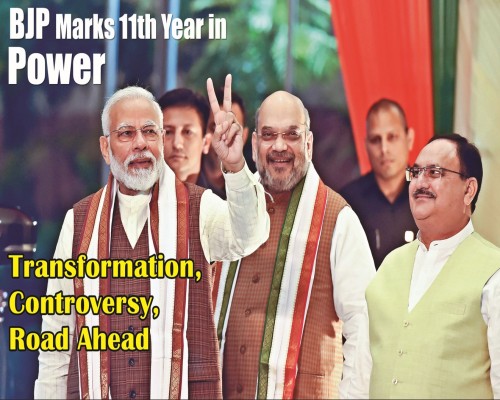
The Bharatiya Janata Party (BJP) commemorated a significant milestone this week: 11 years of uninterrupted rule under Prime Minister Narendra Modi, who first took office on 26 May 2014. While the government proudly highlights sweeping reforms and infrastructural investments under its "Viksit Bharat" vision, the opposition accuses it of democratic erosion and unmet promises. This report dissects the headline figures, public perception, and policy dynamics that define this juncture.
1. BJP’s Narrative: A “Golden Era” of Governance
- Performance-driven politics: BJP President J.P. Nadda proclaimed the past decade marked a shift from traditional "appeasement" to "performance, accountability, and responsible governance"
- Golden on all fronts, says Amit Shah: Home Minister Amit Shah lauded the period as one of "resolve, endeavour and dedication toward public service," highlighting economic revival, social justice, and security
- Regional leaders back themes:
- UP CM Yogi Adityanath emphasized enhanced military posture with "Operation Sindoor," infrastructural growth, expanded AIIMS medical coverage, and welfare uplift via schemes like Lakhpati Didi Yojana
- Rajasthan CM Bhajan Lal Sharma underscored central transfers (₹2.11 lakh crore), free grains to over 4.5 crore poor under PM-Garib-Kalyan Yojana, and upcoming elevated road construction
- National press outreach: Across press conferences—from Jharkhand to Mizoram—leaders highlighted landmark measures: Article 370 abrogation, vaccine exports to 160 nations, Jyotirmay Jal Jeevan, Ujjwala, PMAY (housing), Digital India, Jan Dhan banking, Ayushman Bharat, and rural electrification
2. The Hard Numbers: Economy & Infrastructure
- Growth: India’s GDP has expanded to approximately $4.2 trillion, ranking fourth globally. Growth rates averaged 6.4 percent, even hitting 7.4 percent in the latest quarter.
- Inflation: From a peak of 9.4 percent in 2013–14, consumer inflation now stands near 4.6 percent, easing household financial stress .
- Road infrastructure: Under Nitin Gadkari’s highways leadership, national highways grew over 60 percent (91,287 km → 146,195 km), with four‑lane corridors doubling, and high-speed corridors expanding from 93 km to 2,474 km
- Northeast investments: ₹44,859 crore was invested across 3,600 projects, smoothing regional connectivity and development
3. Welfare Push: Social Schemes & Digital Governance
- LPG outreach: Ujjwala Yojana supported clean cooking inside millions of homes.
- Housing and sanitation: PMAY and Swachh Bharat built more than 12 crore toilets and ensured millions of households have access to clean tap water
- Health coverage: Ayushman Bharat covers ~50 crore people; e‑Sanjeevani telemedicine has broadened rural health access
- Finance inclusion: Jan Dhan accounts brought banking access to the unbanked; PM‑Garib-Kalyan Yojana delivered free food grains to crores
- Digital democracy: The government launched its "Jan Man" survey—via the NaMo app—garnering over 5 lakh responses within 26 hours, showcasing participatory governance. An e‑book summarizing the first 11 years across 14 thematic chapters was also released
4. Security & Institutional Overhaul
- Defence posture: Enhanced surgical‑strike capacity (“Operation Sindoor”), the creation of the CDS post, and defense integration underscored national security
- Governance reforms: Demonetization (Nov 2016), implementation of GST (July 2017), abolition of Planning Commission in favor of NITI Aayog, and debate over “One Nation, One Election” display structural changes .
5. Opposition’s Critique: "Misgovernance" & "Democratic Backsliding"
- “Ink of dictatorship”: Congress president Mallikarjun Kharge accused the BJP of eroding democratic institutions, changing the Constitution, and harming India’s democratic standing
- “Zero marks”: Karnataka CM Siddaramaiah gave the government zero for governance, asserting its image was propped by media over actual delivery
- Rahul Gandhi’s critique: He charged that “11 years of Modi government = no accountability, no change, only propaganda” and that minorities and socially vulnerable groups were excluded.
- Democracy & media concerns: Independent analysts suggest democratic backsliding since 2014, citing slippery media freedom and rising centralization of power
6. What’s the Public Saying? Surveys & Sentiment
- India Today / CVoter survey during “To The Point,” revealed voters credited government on reforms but remain uneasy about unemployment and economic disparities
- Business sentiment: After the 2024 election, the FT warned that the BJP “suffered setbacks, ... voters expressed dissatisfaction… job scarcity, high inflation, poverty, and inequality,” flagging the need for grassroots responsiveness
7. In-depth Spotlight: Key Themes & Impacts
Infrastructure Acceleration
- Speed of highway construction rose from ~12 km/day in 2014 to over 34 km/day in 2025. Rural roads now connect nearly 99 percent of villages.
- High‑speed rail corridors reflect ambitions to modernize rail transport.
Healthcare & Pandemic Response
- The Ayushman Bharat insurance scheme covers tens of millions; e‑Sanjeevani telemedicine surges post‑COVID.
- Vaccine diplomacy placed India at the centre of global health, helping 160+ countries.
Digital Governance & Citizen Interface
- The NaMo app’s Jan Man Survey invited public input; rapid uptake indicates hunger for participatory tools.
- Faceless tax reforms and the e‑book signaled moves toward transparency.
Social Divides & Legal Flashpoints
- Laws like CAA 2019 and Article 370’s revocation ignited protests. CAA excludes Muslim migrants, sparking debate over secularism.
- Analysts point to tightened media space—“godi media”—and suppressive tactics against dissent.
8. Political Base & Electoral Outlook
- Third term challenge: The 2024 election yielded a reduced BJP tally; dependence on coalition partners has increased, raising investor worries .
- India Bloc rises: Opposition’s INDIA coalition criticized “misgovernance,” tribal neglect, constitutional overreach, and unemployment.
- Govt counters: BJP points to sustained development, social welfare, and foreign diplomacy as signs of public mandate .
9. Public Policy: Gains, Gaps, Going Forward
|
Domain |
Gains Highlighted by BJP |
Criticisms Raised by Opposition |
|
Economy |
GDP growth, controlled inflation |
Job creation lagging, rising inequality |
|
Infrastructure |
Road expansion, rural connectivity |
Neglect of last-mile and sectoral nuance |
|
Welfare |
LPG, housing, banking, digital health |
Implementation gaps, exclusion concerns |
|
Governance Reform |
GST, demonetization, NITI Aayog establishment |
Disruption to informal sector, centralization |
|
Security |
Surgical strikes, CDS post, defence expansion |
Civil rights, minority alienation |
|
Democracy |
Electoral innovation, digital engagement |
Media suppression, institutional weakening |
10. What Comes Next?
- Govt strategy: BJP is pushing “Continuity & Reform,” focusing on land asset monetization, social security for the middle class, skill-led employment, and formal sector growth.
- Opposition roadmap: INDIA coalition plans to exploit joblessness, inflation, civil liberty constriction, and democratic decay in ambitious state and upcoming national elections .
- Public pulse: Surveys and social media platforms (like Reddit and Twitter) reflect mixed sentiments—admiration for visible development, but rising impatience over inequality and unemployment.
🔍 Final Word
After eleven years, the BJP-led NDA presents a complex legacy: vast physical infrastructure, digital rollouts, welfare programs, and international visibility versus persistent unemployment, social fissures, and democratic backsliding. As Modi enters his third term, the challenge is clear—translate structural gains into palpable progress for India's youth, workers, minorities, and rural citizens. The next few years will determine if this era is truly "golden" or merely gilded.