
BJP’s Expanding Political Dominance Sparks Debate on the Future of Indian Politics
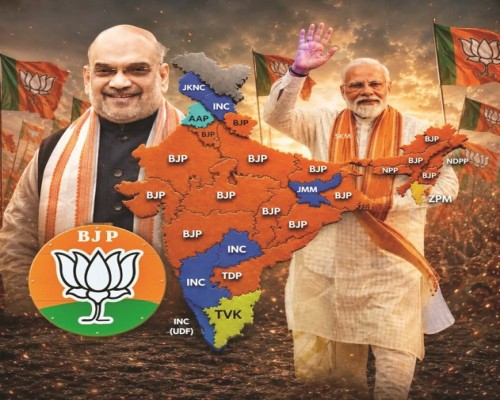
A recent political analysis has reignited discussions about the evolving landscape of Indian politics, suggesting that the Bharatiya Janata Party (BJP) and Prime Minister Narendra Modi have further consolidated their position as the dominant force in the country. The assessment argues that a combination of electoral success, organizational strength, ideological clarity, and opposition fragmentation has strengthened the BJP’s prospects for maintaining its influence well into the coming decade.
The analysis points to the party’s expanding footprint beyond its traditional strongholds, particularly in regions where it once struggled to establish a significant presence. Electoral gains in eastern and southern India are cited as evidence of the BJP’s ability to broaden its appeal and attract new voter bases. Political observers note that the party has increasingly succeeded in challenging long-established regional political forces, thereby reshaping the electoral map of the country.
A key factor highlighted in the study is the continued consolidation of Hindu voters across multiple states. According to political analysts, the BJP’s strategy of combining cultural and ideological messaging with welfare initiatives and strong leadership has helped it maintain a broad support base. The party’s ability to unify diverse sections of voters under a common political narrative has emerged as one of its most significant strengths.
The report also emphasizes the role of organizational efficiency. The BJP’s extensive grassroots network, disciplined cadre structure, and election management capabilities have enabled it to convert political support into electoral victories more effectively than many of its rivals. Analysts argue that this organizational advantage has become a decisive factor in modern Indian elections.
Another major theme in the analysis is the condition of the opposition. While several opposition parties continue to command regional influence, the absence of a cohesive national alternative and a widely accepted leadership figure has limited their ability to mount a sustained challenge. Political commentators suggest that ideological differences, leadership disputes, and electoral rivalries among opposition groups have weakened efforts to build a unified front.