
DRDO Develops Portable Device to Convert Seawater into Drinking Water
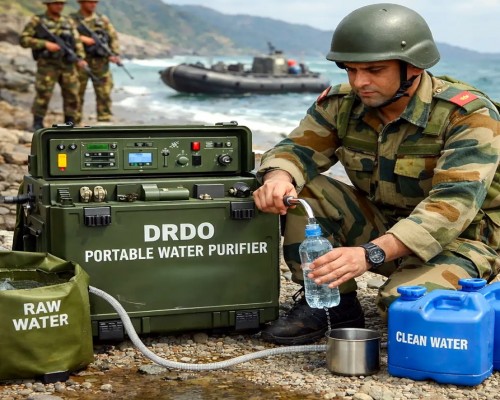
India’s Defence Research and Development Organisation (DRDO) has developed a portable device capable of converting seawater into safe drinking water. The innovation is designed to be compact and easy to operate, enabling users to produce potable water directly from the sea using a handheld or portable system.
The technology aims to address one of the major challenges faced by people living near coastal regions and by personnel deployed in maritime environments. Although oceans contain vast quantities of water, the high salt content makes seawater unsuitable for direct consumption. The newly developed device uses desalination technology to remove salt and impurities, making the water safe for drinking.
According to DRDO officials, the device is based on advanced seawater purification and desalination technology developed in research laboratories. Unlike traditional desalination plants that require large infrastructure and high investment, the new system is designed to operate on a small scale and can be deployed quickly in remote locations.
One of the key advantages of the device is its portability and rapid installation capability. The system can be set up in approximately two to three minutes, allowing users to begin producing drinking water almost immediately. The device can generate enough purified water in a day to meet the drinking needs of around 20 to 25 people.
The water produced by the device is designed to meet established drinking water standards. The system removes salt and other contaminants, ensuring that the resulting water is safe for human consumption.
Traditional desalination plants used in coastal areas often involve large infrastructure, complex equipment, and significant financial investment. Such facilities are typically built for large-scale water supply systems. However, these installations are not always practical for remote areas, disaster situations, or field operations.
The portable system developed by DRDO addresses this gap by offering a compact and cost-effective solution. It allows seawater to be purified without the need for large-scale infrastructure, making it suitable for use in remote coastal environments and emergency situations.
The device is expected to be particularly useful for security forces operating in maritime areas, including naval personnel and coastal security units. Military personnel stationed on remote islands, ships, or coastal outposts often face challenges in accessing fresh drinking water. The portable desalination system could provide a reliable solution in such situations.
In addition to defence applications, the technology could also benefit civilian populations in coastal regions. Many coastal communities face water shortages despite being located close to the sea. The new device could help provide an alternative source of drinking water for such areas.
Experts believe the system could also be valuable during natural disasters such as cyclones or floods, when access to clean drinking water is often disrupted. A portable desalination unit could quickly provide safe water supplies during emergency relief operations.
The development reflects India’s ongoing efforts to strengthen technological capabilities in water purification and environmental sustainability. By combining scientific research with practical applications, institutions like DRDO continue to develop solutions that can address real-world challenges faced by both civilian communities and security forces.
Overall, the portable seawater desalination device represents a promising step toward improving access to safe drinking water in coastal regions and maritime environments. If deployed widely, such innovations could help support both disaster response operations and the daily water needs of communities living near the sea.