
India to Conduct Its First-Ever Digital Census in 2027
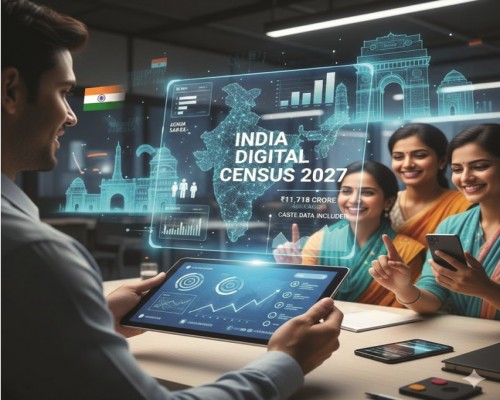
India is set to conduct its first fully digital population census in 2027, marking a historic shift in the way demographic data is collected and managed. The Union Cabinet has approved the proposal to carry out the census in two phases, introducing technology-driven processes for data collection, monitoring, and dissemination on an unprecedented scale.
The census will be implemented at an estimated cost of ₹11,718.24 crore and will involve the deployment of more than 30 lakh field workers across the country. For the first time, census data will be collected digitally using mobile applications and centrally monitored through a dedicated digital platform to ensure accuracy, transparency, and real-time supervision.
Under the approved plan, the census will be conducted in two stages. The first phase, scheduled to begin in April 2026, will focus on house listing and housing enumeration, during which detailed information about residential structures and living conditions will be recorded. The second phase, planned for February 2027, will involve the actual population enumeration. During this phase, caste-related data will also be collected in electronic form for the first time in India’s census history.
Certain regions, including the Union Territory of Ladakh and the snow-bound areas of Jammu and Kashmir, Himachal Pradesh, and Uttarakhand, will complete their second phase earlier, beginning in September 2026, in view of geographical and climatic conditions.
The government has stated that the digital census will rely on a mobile-based data collection system supported by a Census Management and Monitoring Portal. This platform will enable real-time tracking of field operations, ensure timely resolution of discrepancies, and enhance the overall reliability of the data. Enumerators will also have the option to allow citizens to self-enumerate through a secure digital interface, further increasing participation and data accuracy.
Officials have emphasised that the shift to digital methods will improve data quality, reduce processing time, and allow for more advanced visualisation and analysis of results. Census findings will be presented through user-friendly dashboards and visual tools, making demographic insights more accessible for policymakers, researchers, and the public. Data will be made available down to the village and ward levels, strengthening evidence-based planning at the grassroots.
The scale of the operation remains vast. Approximately 30 lakh enumerators, most of whom are government school teachers, will be engaged on a temporary basis in addition to their regular duties. Supervisory staff will be appointed at sub-district, district, and state levels to oversee implementation and ensure uniform standards across regions.
The census is being positioned as a cornerstone for social and economic policymaking in a country marked by vast demographic, cultural, and regional diversity. Authorities have underlined that high-quality, standardised data is essential for effective governance, targeted welfare delivery, infrastructure planning, and long-term development strategies.
The last population census, conducted in 2011, recorded India’s population at 121.02 crore, comprising 62.37 crore men (51.54 percent) and 58.65 crore women (48.46 percent). The upcoming digital census will provide the most comprehensive and technologically advanced update to India’s demographic profile since Independence.
With digital data collection, centralised monitoring, and enhanced analytical capabilities, Census 2027 is expected to redefine how population data is gathered and used in India. The initiative represents a major step toward data-driven governance, enabling faster policy responses and more precise planning for the nation’s future.