
Noida International Airport: India’s Next Big Economic Engine
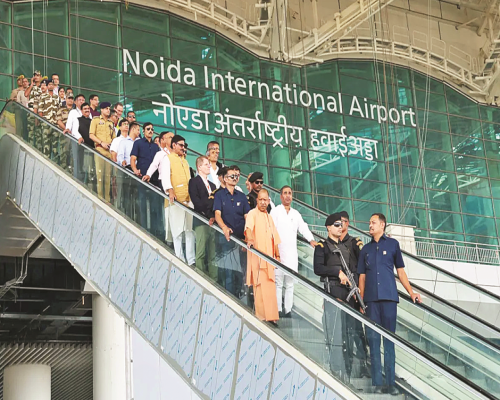
How Jewar’s mega-airport project is poised to reshape North India’s industrial, logistics and tourism map
The Idea Takes Flight
Few infrastructure projects in modern India have inspired as much anticipation—and scrutiny—as the Noida International Airport (NIA) rising from the fertile plains of Jewar in western Uttar Pradesh.
Far more than a transport hub, this greenfield aviation complex is a strategic economic lever—a test case for how airports can catalyse growth, decentralize opportunity, and anchor India’s next decade of mobility-led expansion.
Set along the Yamuna Expressway, some 70 kilometers from the heart of Delhi, the project is being executed by Yamuna International Airport Private Limited (YIAPL)—a wholly owned subsidiary of Zurich Airport International AG—under a public-private partnership (PPP) with the Government of Uttar Pradesh. Its counterpart, Noida International Airport Limited (NIAL), serves as the state government’s implementing agency.
For Uttar Pradesh, the stakes are profound. For India, the implications are national.
Why Jewar Matters
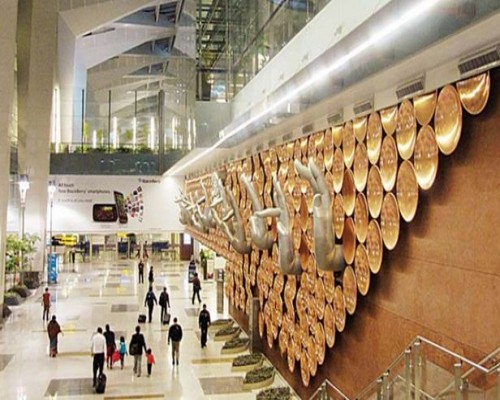
India’s civil aviation sector is at an inflection point. Air passenger traffic—domestic and international—is expanding steadily, straining the capacity of major metros. Delhi’s Indira Gandhi International Airport (IGIA), despite being among the busiest in Asia, faces saturation pressures.
Jewar offers the logical expansion route. Positioned along the Yamuna Expressway corridor, the airport sits at the confluence of industrial clusters, logistics arteries, and emerging smart cities like Greater Noida. Its reach extends into the manufacturing hubs of Aligarh, Bulandshahr, Agra, and even parts of Madhya Pradesh and Rajasthan.
“Noida International Airport isn’t just about decongesting Delhi—it’s about democratizing growth,” notes an aviation analyst. “It brings the global economy closer to Uttar Pradesh’s heartland.”
The Architecture of Ambition
The master plan of NIA reflects precision, scalability, and foresight. The airport’s Phase 1 is being built to handle 12 million passengers annually, with provisions for seamless modular expansion to 70 million passengers per annum across future phases.
- Runways: Phase 1 includes a 3,900-meter runway, designed to accommodate wide-body aircraft. Later stages envision up to four parallel runways.
- Terminal Design: The terminal—conceptualized by Nordic Office of Architecture, Grimshaw, Haptic, and STUP—is inspired by the Indian courtyard, merging Swiss efficiency with Indian warmth.
- Sustainability: NIA is committed to being a net-zero carbon airport, powered by renewable energy and optimized for natural ventilation, daylight, and water recycling.
- Digital-first Operations: From DigiYatra-enabled biometrics to AI-driven baggage management, the airport’s infrastructure is designed for seamless, contactless travel.
The terminal architecture is symbolic—a modern haveli bathed in sunlight, framed by native landscaping, representing both global sophistication and local identity.
The Economic Multiplier
Noida International Airport is expected to transform western Uttar Pradesh into one of India’s most dynamic economic zones.
Its impact radiates across four powerful vectors: industrial manufacturing, logistics and cargo, tourism, and urban real estate.
1. Industrial & Manufacturing Push
The airport’s location is strategic—embedded within the Yamuna Expressway Industrial Development Authority (YEIDA) zone. Industrial estates for electronics, textiles, auto-components, and food processing are already operational nearby.
Jewar’s air connectivity will give these sectors a decisive export edge. Just-in-time manufacturing, precision logistics, and reduced transit times can lower supply-chain costs by up to 25%, according to industry estimates.
“An airport is the heartbeat of industrial competitiveness,” says a senior YEIDA official. “It connects factory floors to foreign markets overnight.”
2. Cargo & Logistics Hub
At the core of NIA’s design is a Multi-Modal Cargo Hub (MMCH), being developed jointly with Air India SATS (AISATS) on roughly 80–87 acres.
This hub will feature:
- Dedicated Coolport facilities for perishables and pharmaceuticals
- Bonded warehousing
- Express courier terminals
- Real-time cargo tracking systems integrated with customs
- Access to rail and road freight corridors
Initial cargo throughput capacity is estimated at 0.25 million tonnes annually, with scalability built into the master plan.
Combined with the Delhi–Mumbai Expressway and Dedicated Freight Corridor (DFC), Jewar’s MMCH can position NCR as northern India’s logistics powerhouse.
3. Tourism & Regional Gateway
Few airports globally sit at such an intersection of heritage and hospitality.
From Jewar, Agra’s Taj Mahal, Mathura-Vrindavan’s spiritual circuit, and Rajasthan’s palaces are within a few hours’ reach. Uttar Pradesh’s tourism roadmap identifies NIA as the cornerstone for a “Golden Triangle 2.0,” linking Delhi–Agra–Varanasi via expressways and regional air links.
The airport is also expected to attract inbound international charters, religious tourism, and meetings and conventions (MICE) travel, supported by hotels, convention centers, and retail zones within its “aerocity” precinct.
4. Urban & Real Estate Growth
Like Gurugram once did with IGIA, the regions of Jewar, Dankaur, and Tappal are expected to witness a dramatic urban evolution. Land values along the expressway have already surged, prompting new housing projects, logistics parks, and institutional campuses.
The planned Aerotropolis—spanning residential, commercial, and entertainment zones—aims to create a self-sustaining urban ecosystem around the airport, generating thousands of jobs in construction, services, and trade.
Sustainability as Strategy
Noida International Airport aims to be India’s first net-zero emissions airport of its size. Sustainability is embedded, not appended.
- Energy: Rooftop solar plants, LED lighting, and energy-efficient HVAC systems minimize carbon intensity.
- Water: Rainwater harvesting, zero discharge wastewater treatment, and water-efficient landscaping reduce ecological stress.
- Materials: Locally sourced stone and renewable materials limit embodied carbon.
- Biodiversity: Large green belts and buffer plantations create a microclimate around the airfield.
Zurich Airport’s global expertise in green design and India’s policy push for sustainable infrastructure converge here. For aviation, it’s a test case of how environmental stewardship can coexist with large-scale development.
“Sustainability is not a choice—it’s our foundation,” said a Zurich Airport executive during the project’s design phase. “We are building for the next hundred years.”
The Connectivity Equation
A great airport is defined as much by its access as by its architecture. Jewar’s connectivity blueprint is designed as a multi-layered grid.
Road Network
- Yamuna Expressway: The airport directly fronts the 165-km expressway linking Noida to Agra, ensuring high-speed vehicular movement.
- Eastern Peripheral Expressway: Connects the site to Ghaziabad, Sonipat, and Palwal.
- Faridabad–Jewar link road: Provides alternate southern approach.
- Dedicated airport access road: Ensures smooth last-mile ingress.
Rail & Metro Integration
- The Ghaziabad–Noida–Jewar Regional Rapid Transit System (RRTS) is planned to connect the airport with the wider NCR network.
- The Noida Metro Aqua Line will be extended to the Boraki Multi-Modal Transport Hub, offering interchange options for metro, RRTS, and intercity buses.
Together, these will make NIA a seamlessly accessible multimodal hub, crucial for both passengers and cargo operators.
Governance & Financing Framework
Noida International Airport exemplifies India’s evolving PPP model in infrastructure.
|
Stakeholder |
Role |
|
Zurich Airport International AG (YIAPL) |
Developer, operator, and concessionaire for 40 years |
|
Noida International Airport Ltd (NIAL) |
Government SPV (UP government) overseeing project |
|
Tata Projects Ltd |
EPC contractor for Phase 1 works |
|
YEIDA / Govt. of UP |
Land development, external infrastructure, industrial integration |
The total project investment across phases runs into tens of thousands of crores, including land acquisition, airside works, terminal construction, and connectivity projects. Zurich Airport has committed long-term operational expertise, while the state provides facilitation and regulatory backing.
The financing structure relies on a hybrid revenue model—combining passenger service charges, cargo fees, commercial concessions, and real estate development. This blend ensures viability beyond aeronautical revenue alone, aligning with global best practices.
Community and Environmental Governance
Building a world-class airport in a region of villages, farms, and wetlands demands sensitivity.
Land acquisition in Jewar affected several villages, including Dayanatpur, Ranhera, Karauli Bangar, and Mudrah. The government implemented a structured rehabilitation and resettlement (R&R) plan, offering compensation, alternative housing, and livelihood programs.
Environmental impact assessments (EIA) have included studies on groundwater, air quality, flora and fauna, and avian movement. Measures such as buffer plantations, noise barriers, and wildlife monitoring are part of the compliance framework.
Such governance mechanisms are not merely statutory—they shape the project’s social legitimacy.
The Wider Economic Canvas
Economists see NIA as the linchpin of a new economic corridor stretching from Delhi NCR to Agra and beyond.
Its multiplier effect can be dissected into measurable impacts:
- Employment Generation: Over 50,000 direct and indirect jobs expected during initial phases—ranging from construction and operations to hospitality and logistics.
- Industrial Catalysis: Proximity to sectors like electronics, apparel, and automotive will boost exports.
- Investment Magnet: Ancillary investments in roads, metros, utilities, and real estate can exceed the airport’s direct capital outlay.
- Regional Balance: Diversifying growth away from Delhi and Gurugram, it fosters new centers of economic gravity in Uttar Pradesh.
In short, the airport could well become North India’s largest single driver of regional GDP in the next decade.
Technology at the Core
Digitalization is not an add-on—it is a design DNA at NIA. The airport aims to function as a smart infrastructure platform.
- DigiYatra Integration: Seamless biometric travel experience for passengers.
- AI-Powered Operations: Predictive maintenance, queue management, and airside analytics.
- Smart Cargo Systems: IoT-enabled tracking, e-customs clearance, and blockchain-based documentation.
- Data-driven Sustainability: Continuous monitoring of energy, emissions, and waste metrics through integrated dashboards.
This blend of aviation, analytics, and automation positions NIA as a benchmark for future-ready airports—where convenience and efficiency coalesce.
Strategic Advantage: The Location Edge
Jewar’s geography gives it rare leverage. It sits at the crossroads of India’s largest consumer base (NCR) and its densest industrial heartland.
The catchment area spans multiple million-plus cities: Noida, Ghaziabad, Agra, Faridabad, Aligarh, Bulandshahr, and Mathura.
Crucially, the airport’s proximity to expressways and freight corridors links it directly with the Delhi–Mumbai Industrial Corridor (DMIC). This synergy between air, road, and rail logistics could redefine cost efficiencies for industries across northern India.
From apparel exporters in Noida to electronics assemblers in Dadri, from auto-component suppliers in Aligarh to food processors in Hathras—Jewar becomes their global gateway.
Investor Confidence & Global Parallels
Globally, airports like Munich, Istanbul, and Incheon have transformed regions into growth magnets. Jewar aspires to replicate that model in the Indian context.
Zurich Airport’s track record lends credibility: its expertise in airport design, sustainability, and commercial management bridges global best practices with Indian realities.
Investors view NIA as part of a broader structural shift—infrastructure-led regional rebalancing—similar to how Hyderabad’s airport shaped Telangana’s growth story or how Navi Mumbai Airport will amplify Maharashtra’s.
For private equity and industrial developers, the combination of a new airport, expressways, and industrial parks signals an opportunity-rich frontier.
Pull-Quote Sidebar
“Jewar is not just another airport. It’s the heartbeat of a new growth story—where the runway meets the factory floor.”
— Editorial Analysis, Udyog Vihar Business Review
Beyond Aviation: A Platform for Partnerships
The state government has aligned policies around the airport to attract MSMEs, startups, and training institutions. The proposed Aviation Skill Development Centre will equip local youth for airport operations, ground handling, hospitality, and security.
Collaborations with universities and industry bodies are planned to create a regional knowledge ecosystem, ensuring local communities evolve alongside the infrastructure.
The airport is also a template for inter-governmental collaboration—between the state, central ministries, and international concessionaires—demonstrating how coordinated governance can accelerate complex infrastructure delivery.
Risks on the Horizon
No mega-project is immune to challenges. Key watchpoints for Jewar include:
- Connectivity execution: Timely completion of expressway spurs, metro links, and RRTS lines.
- Airline adoption: Securing anchor carriers and balancing operations between IGIA and NIA.
- Land-use discipline: Avoiding speculative, unplanned sprawl around the aerotropolis zone.
- Sustainability enforcement: Ensuring environmental commitments are maintained in operation, not just design.
- Community inclusion: Delivering visible socio-economic dividends to local populations.
How these are managed will determine whether Jewar becomes an enduring success story or another infrastructure promise stretched thin.
Fast Facts: Noida International Airport
|
Feature |
Detail |
|
Location |
Jewar, Gautam Buddha Nagar, Uttar Pradesh |
|
Developer |
Zurich Airport International AG via YIAPL |
|
Government Partner |
Noida International Airport Ltd (NIAL) |
|
Phase 1 Capacity |
12 million passengers annually |
|
Ultimate Capacity |
Up to 70 million passengers annually |
|
Runways (Planned) |
Up to four |
|
Cargo Hub |
80–87 acre AISATS-led MMCH |
|
Design Partners |
Nordic, Grimshaw, Haptic, STUP |
|
Sustainability Goal |
Net-zero emissions |
|
Access |
Yamuna Expressway, EPE, RRTS, Metro, DME |
|
IATA / ICAO Code |
DXN / VIND |
A New Growth Epicentre
In economic geography, airports are not endpoints—they are catalysts.
The Noida International Airport’s rise encapsulates India’s 21st-century growth logic: infrastructure as strategy, not just as service.
It unites four ideas into one platform:
- Mobility: connecting people and goods faster.
- Manufacturing: powering export-led growth.
- Sustainability: building green from the ground up.
- Inclusivity: ensuring communities prosper alongside development.
The runway at Jewar may soon carry aircraft, but the flight path it charts is much longer—toward a future where Uttar Pradesh stands as a global industrial gateway.
Final Word
When the first aircraft lifts off from Jewar, it will symbolise more than air connectivity. It will mark a shift in India’s development narrative—from centralised megacities to regional growth clusters, from congestion to capacity, from reactive expansion to proactive planning.
Noida International Airport is that rare infrastructure project where vision, viability, and velocity converge.
It is where the story of New India—aspirational, efficient, and sustainable—quite literally takes wing.