
Noida’s April 2026 Workers’ Uprising: Wages, Heat and Hidden Hands
In the sprawling industrial township of Noida in the northern state of Uttar Pradesh, thousands of workers downed tools and marched out of factories in mid‑April 2026. The protests were unprecedented in scale. They began on 10 April at the Phase 2 hosiery complex and soon engulfed factories owned by the Motherson Group, Richa Global Exports and numerous garment exporters, shutting roughly 300 units and paralyzing production. What started as demands for wage parity with neighbouring Haryana’s factories quickly escalated into an industrial uprising that would reverberate across India’s wage debate, exposing deeper fault lines in the country’s labour model and drawing attention to under‑appreciated triggers such as climate stress, soaring living costs and cross‑border disinformation.
Origins: A wage gap and a cost‑of‑living crisis
The immediate catalyst for the unrest was a dramatic 35 per cent hike in Haryana’s minimum wage in early April. Haryana’s new rules raised the monthly pay of unskilled factory workers from around ₹11,274 to ₹15,220. For workers in Noida and nearby Ghaziabad, who were earning roughly ₹11,313 a month, the disparity felt like a betrayal. They argued that their wages had lagged behind surging prices for food, rent and fuel, and demanded a minimum monthly salary of ₹20,000. Many of these workers were migrants from Bihar and eastern Uttar Pradesh. They lived in cramped, poorly ventilated rooms, paying rents of ₹6,000–7,000 and sharing spaces with multiple occupants to reduce costs. Cooking gas cylinders sold for ₹3,000–4,000 due to the West Asia war’s impact on energy supplies, forcing many families to cook over makeshift chulhas and to take loans to buy essentials. With wages barely covering rent and food, most relied on overtime to earn enough to send money home.
The cost‑of‑living crisis was not limited to commodities. As one worker, Pushparaj, told reporters, his take‑home pay of ₹11,313 barely allowed him to support his family; after paying rent and sending money home, he had no cushion for emergencies. Shreya Ghosh of the Sangrami Gharelu Kamgar Union said the agitation was not just about wages but about the dignity of workers forced to compromise on health and hygiene; many lacked access to proper toilets and safe drinking water. Others spoke of skipping meals or denying themselves medical care because falling sick would mean losing pay. Economic analysts noted that while nominal wages in India’s labour‑demanding states had risen, they were eroded by inflation. Between 2021 and 2026, all‑India inflation was 26.6 per cent and food prices rose 28 per cent, eating up much of workers’ wage gains.
April 13: A protest turns violent
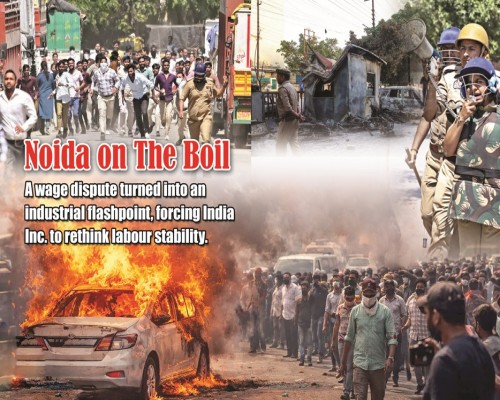
On 13 April, the protests entered their fourth day and turned violent. Thousands of workers poured onto the streets, torched vehicles and hurled stones, confronting security forces. Reuters reported that police lobbed tear gas shells and used “minimum force” to disperse the crowds. Visuals showed overturned cars in flames and protesters trying to break through barricades. Gautam Budh Nagar police said about 40,000 workers participated in the demonstrations; seven criminal cases were registered, and more than 300 people were arrested. Legislators urged dialogue, but the violence underscored how quickly economic grievances could morph into public disorder. Workers like Vinay Mahoti from Bihar, who worked at a hosiery company, said they initially protested inside their units but joined the larger crowd when they felt their demands were being ignored. He insisted that duty hours must be fixed, overtime paid, and companies adhere to federal labour guidelines.
The unrest was not limited to wage demands. Noida, one of Asia’s largest planned industrial townships, houses thousands of factories, including electronics, auto parts and garment units. Many companies were already grappling with supply‑chain disruptions from the U.S.–Israel conflict with Iran, which had curbed fuel supplies and pushed up input costs. When protests forced plants to shut, production lines halted, and the images of burnt police vehicles threatened to damage the region’s reputation as an investment destination.
Interim wage hike and persistent discontent
Responding to the violence, the Uttar Pradesh government announced an interim wage revision on 14 April. Unskilled workers’ monthly salaries in Noida and Ghaziabad were raised from ₹11,313 to ₹13,690; semi‑skilled workers’ pay increased from ₹12,445 to ₹15,059; and skilled workers’ wages went from ₹13,940 to ₹16,868. The pay hike was to be applied retroactively from 1 April. Government sources estimated the increase would lift unskilled workers’ earnings from about $121 to roughly $147 per month. Officials framed the hike as a gesture of goodwill and promised to finalise permanent rates after consultations in May. However, many protesters regarded the raise as inadequate. Sheetal Dixit, who worked at an automobile company, told Reuters that workers were not happy with the new wages and considered them unfair. Some felt that after deductions for provident fund and state insurance, their take‑home pay would remain below what was needed to live in the National Capital Region.
The wage hike also triggered debates about economic implications. A commentary in The Economic Times noted that a 20 per cent jump in minimum wages is rare among Indian states. Critics worried the hike would raise operating costs for employers, strain margins and lead to slower hiring or job losses. Yet the same analysis emphasised that across India inflation had eroded real wages, and in many labour‑demanding states wage growth was barely keeping pace with price increases. In labour‑supply states like Bihar and Odisha, wages had grown faster than inflation, narrowing interstate gaps but from a low base. Analysts called for a more granular, data‑led approach to setting minimum wages at district or cluster level, reflecting variations in cost of living and industrial productivity. They argued that higher wages need not hurt jobs if coupled with targeted support to micro and small enterprises, such as tax relief and wage subsidies.
Cross‑border disinformation and the arrest of activists
As the protests escalated, investigators discovered that some social‑media posts fuelling the unrest originated across the border. Police said two accounts on X (formerly Twitter) that shared videos and false claims—among them that 20 workers had been killed and 99 injured—were operated from Jhelum city in Pakistan. The posts, circulated via VPNs, aimed to provoke tensions and included inflammatory messages that questioned authorities’ actions. The investigation uncovered recovery e‑mail addresses and began probing the funding network behind the campaign. Senior police officials alleged that WhatsApp groups used to mobilise workers were created around 9–10 April via QR codes, suggesting a level of coordination.
The focus quickly turned to local activists accused of orchestrating the protests. Among those named were Manisha Chauhan, Rupesh Rai, Satyam Verma and Aditya Anand—a translator associated with the workers’ collective Bigul Mazdoor Dasta—along with students from unions such as AISA and Disha. A case under non‑bailable sections of the Bharatiya Nyaya Sanhita (India’s new criminal code) was registered, prompting a nationwide manhunt for the so‑called mastermind, Aditya Anand. On 18 April, Anand was arrested in Tiruchirappalli in Tamil Nadu after days on the run. Uday India reported that he had shaved his beard and altered his appearance, and that a reward of ₹100,000 had been announced for his capture. The police said he was linked to earlier agitations and had used QR‑code‑based groups to coordinate the Noida strike. Another co‑accused, labour activist Satyam Verma, was denied bail after a court found the charges serious and non‑bailable. Judge Virek Aggrawal noted that Verma was accused of blocking roads, gheraoing a police station and pelting stones, causing injuries to police personnel on 10 April. The court also pointed out that other activists were accused of damaging gates, CCTV cameras and glass panels at factory premises and setting a police vehicle on fire.
Government crackdown on contractors and calls for fairness
The unrest exposed deficiencies in Noida’s labour contracting system. During inspections following the protests, the labour department served notices on 245 contractors for violations of labour laws. When many ignored the notices, officials cancelled the licences of 25 contractors, barring them from employing contract labour; within a week another 14 licences were revoked, bringing the total to 49. Authorities recommended blacklisting the companies involved and directed principal employers to pay wages directly to workers. The Economic Times reported that the district administration also ordered contractors to pay ₹1.16 crore in dues to workers and made overtime payable at double rates. These steps were intended to ensure that the wage hike reached workers and to deter fly‑by‑night contractors, many of whom had evaded statutory benefits.
Chief Minister Yogi Adityanath took a dual approach of conciliation and toughness. In a video conference on 15 April, he acknowledged that every worker has the right to dignified working conditions, full and timely wages and statutory benefits. He ordered strict legal action against violators and a zero‑tolerance approach toward organisations inciting unrest. Adityanath instructed officials to conduct third‑party surveys of industrial units, identify non‑genuine agitators and display their photographs to expose conspiracies. He also emphasised building dormitories and affordable housing for migrant workers and establishing grievance cells to resolve complaints quickly. These directives signalled the government’s recognition that poor living conditions and exploitative contracting had contributed to the crisis.
Living with less: A worker’s perspective
Behind the statistics were tens of thousands of individual stories of hardship. Many unskilled workers in Noida were earning roughly ₹11,313 a month before the protests. Their single‑room apartments often lacked adequate ventilation and sanitation. A Times of India report described how Pushparaj, an unskilled worker, paid ₹7,000 in rent for a cramped room and sent ₹7,000 home to his family, leaving barely any funds for himself. To supplement his income he had to work overtime, sometimes up to 12 hours a day. Another worker said that when his father fell ill, he borrowed money at high interest to fund treatment because missing work was not an option. The article noted that 87 per cent of workers surveyed reported heat‑related symptoms such as headaches and dizziness, while 69 per cent said heat had affected their ability to work. Many skipped toilet breaks to meet production targets, nearly doubling their heat‑stress levels; 45 per cent showed signs of dehydration.
Union leader Shreya Ghosh argued that even with the wage hike, workers would continue to struggle. “Our fight is for the right to live with dignity,” she said, noting that wages as low as ₹11,000 forced workers to compromise on health and hygiene. Her comments underscored the gap between wages and the real cost of urban living. The Deccan Herald highlighted that the cost of cooking gas had surged to ₹3,000–4,000 a cylinder and that inflation in food and rent had left workers no choice but to take overtime or leave their families behind. Economic pressure, coupled with long working hours and poor living conditions, created an environment ripe for unrest.
The invisible trigger: Heat stress and climate change
While wages and inflation dominated headlines, some researchers argued that an invisible factor—climate‑induced heat stress—played a role in the protests. In February 2026, HeatWatch and the Tata Institute of Social Sciences published a study titled Breaking Point: Heat and the Garment Floor. The research surveyed 115 garment workers across 15 factories in Tamil Nadu, Delhi‑NCR and Gujarat. It found that 87 per cent of respondents experienced heat‑related symptoms such as headaches, dizziness and muscle cramps in the preceding year, and 69 per cent said heat affected their ability to work. As temperatures in Noida hovered between 36 °C and 39 °C in mid‑April, forecasts warned they could reach 42 °C. Factory floors were described as “heat traps”: most had metal or asbestos roofs, jet‑dyeing machines operated at 125 °C–130 °C, and only four of the surveyed factories monitored temperature and humidity—and even then the sensors were activated only during buyers’ visits.
The study observed that skipping toilet breaks and dehydration increased heat stress. A 1 °C rise in average temperatures reduced daily earnings by 16 per cent and raised medical expenses by 14 per cent. Delhi’s night‑time cooling capacity—measured as the temperature difference between day and night—had shrunk from 15 °C in 2001 to just 8.6 °C by 2025. Migrant workers living in unventilated rooms carried residual heat load and sleep deficits into their 12‑hour shifts. Despite these findings, India’s Occupational Safety, Health and Working Conditions Code of 2020—legislation that allows 12‑hour workdays—does not explicitly recognise heat as an occupational hazard. Heatwaves are not among the 12 nationally notified disasters, limiting the relief states can provide. Without enforceable standards for factory floor temperatures and mandatory breaks, rising heat may continue to exacerbate worker distress.
Protests for release and continuing legal battles
The crackdown that followed the unrest was swift, but it sparked its own backlash. On 30 April, activists and family members gathered at Jantar Mantar in New Delhi to demand the release of workers and activists arrested in connection with the Noida protests. Organised by a coalition called CaRWAN—the Campaign for Release of Workers and Activists of Noida—the protest involved groups such as the Revolutionary Workers’ Party of India, Disha Students’ Organisation, the All India Students’ Association and Naujawan Bharat Sabha. Protesters alleged that many of those detained had not participated in violence; they called the charges baseless and sought an independent inquiry into the events and the arrests. Relatives of detainees recounted emotional ordeals. Himanshu Thakur’s mother told Hindustan Times that she and her husband had been allowed only one meeting with their son since his arrest on 18 April and that the family lived in constant anxiety. Activists contended that evidence had been planted to implicate workers; they warned that demonstrations would continue until the detainees were freed.
Courts have largely upheld the state’s actions. On 28 April, an additional chief judicial magistrate in Noida rejected bail applications filed by labour activist Satyam Verma and co‑accused Rupesh Rai, Manisha Chauhan and Aakriti Chaudhary, noting that the charges—ranging from criminal conspiracy to mischief causing loss—were serious and non‑bailable. The court said the accused were involved in blocking roads, gheraoing a police station and attacking police and security personnel. Defence lawyers argued that the workers had not breached the peace and that the police had added heavier sections after initially granting interim bail. They contended that the defendants were being targeted for their activism; however, the court ruled that the case must be tried by the sessions court.
The broader wage debate and the road ahead
Noida’s April 2026 protests have sparked a national conversation about how India sets its minimum wages and protects its workforce. Economists point out that the country’s net household savings have fallen from 7.1 per cent of GDP in FY 2015 to 5.2 per cent in FY 2024, while household liabilities have doubled. At the same time, corporate profits reached an all‑time high of 15.5 per cent of GDP in 2025. Under these conditions, workers’ frustrations over stagnant wages and rising costs are likely to persist. Although the Uttar Pradesh government’s wage hike lifted five‑year wage growth to around 50 per cent, this growth still barely outpaces inflation. The disparity between labour‑demanding and labour‑supplying states remains wide, and the migration of millions of workers underscores the need for portable social security and consistent enforcement of labour standards.
Labour activists argue that wage revisions must be accompanied by housing, healthcare and transportation support. They call for the implementation of the code on social security, comprehensive safety norms including heat‑stress guidelines, and enforcement against exploitative contractors. Employers worry about cost pressures but also recognise that underpaid workers cannot sustain productivity. Government officials emphasise the need to balance industrial competitiveness with worker welfare, mindful that global investors are watching how India manages social stability.
Conclusion
The April 2026 Noida workers’ protest was far more than a dispute over pay. It was the flashpoint of converging crises: stagnant wages, runaway inflation, precarious working and living conditions, climate‑induced heat stress and the pernicious influence of disinformation. The episodes of violence and subsequent crackdown have exposed the fragility of India’s industrial relations and the ease with which legitimate labour grievances can be hijacked by outside actors. The government’s response—raising wages, cancelling errant contractors’ licences and promising better housing and grievance redressal—shows an attempt to address immediate triggers. Yet deeper structural reforms are needed. Without ensuring that minimum wages keep pace with the real cost of living, providing workers with safe and cool working environments, protecting migrant labourers from exploitation and insulating industrial zones from foreign‑funded misinformation, similar uprisings may recur. Noida’s protests have thus become a warning bell for policy‑makers: economic development cannot be sustained without dignity and security for those who build it.