
Pan-Northeast political realignment underway: A new party takes shape
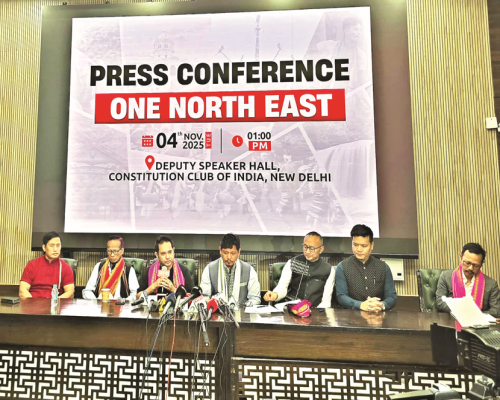
A significant political development is unfolding in India’s Northeast: key regional parties and leaders allied to the Bharatiya Janata Party (BJP) are joining forces to create a new pan-regional political entity that seeks to serve as a unified “indigenous” voice for the region. Among the frontrunners in this initiative are the National People’s Party (NPP) led by Meghalaya Chief Minister Conrad Sangma, and the Tipra Motha headed by Tripura’s Pradyot Manikya Debbarma.
The proposal
At a press conference in Delhi, the leaders announced that their respective parties, along with other smaller regional outfits, would merge into a single political organisation with one common symbol. They argued that despite being part of the national coalition, regional parties across states such as Assam, Nagaland, Meghalaya and Tripura share common issues and identical aspirations — and thus should speak with one voice rather than remain fragmented. The merger is being framed as not a move against any national party or force, but for the people of the Northeast.
Strategic motivations
- Sangma emphasised that while each regional party has its strengths, the collective weight of the Northeast can be amplified only through unity. He invoked the legacy of previous generations of regional leaders and said the younger leaders have reached the conclusion that “our strength lies in unity”.
- Debbarma echoed the sentiment, pointing out issues such as protection for tribal areas under the Sixth Schedule, illegal immigration across international borders, land alienation and challenges faced by Northeastern students and professionals outside the region. He said that many of these problems cut across state boundaries, and thus required “a political voice not just in the Northeast but also outside the Northeast”.
- The NPP, which has a presence in several states besides Meghalaya, has been leading in this initiative and has established a nine-member committee (with James Sangma as convenor) tasked with designing the new party’s structure, modalities and outreach. The committee has been asked to deliver its report within 45 days.
Implications and challenges
The creation of a pan-regional party is a bold attempt at re-shaping political contours in the Northeast. It could complicate national parties’ strategies, challenge the current alignment of alliances, and shift the balance of power in states where the BJP is dominant via regional allies.
However, the initiative faces significant hurdles:
- Translating a merger of multiple parties into a single coherent organisation requires resolving internal leadership ambitions, regional variations, and policy priorities.
- The new entity must craft a credible narrative that appeals both to local identities and wider regional solidarity — balancing local state-specific issues with a broader Northeast agenda.
- As regional parties are currently operating within the BJP-led national coalition in some states, the new entity must clarify whether it will remain allied with the BJP, go independent, or adopt a flexible alliance model.
Why this matters
For business, social policy and governance stakeholders, the emergence of a unified regional party in the Northeast signals multiple shifts:
- A stronger regional voice means potentially more cooperative demands from states for infrastructure, investment, connectivity and institutional strengthening.
- It could also impact how the central government negotiates with states for schemes, resource sharing and border-management initiatives — especially in areas with tribal populations and cross-border dynamics.
- For companies and investors considering expansion into the Northeast, a unified regional political actor may become a key stakeholder or partner in development, infrastructure and local engagement.
The bottom line
As the Northeast undergoes demographic, economic and social transformation, this proposed merger reflects an elevated stage of political consolidation. The leaders behind it are pitching it as a historic step: “various voices of our region coming together to form a united singular political entity.” Whether the new formation will succeed in delivering a genuinely unified voice — and whether it will resonate with voters beyond its current bases — remains a story to watch.
In short: in a region long characterised by multiple, fragmented parties tied to state identities, a new pan-regional party is taking shape — one that may redefine political bargaining and power in the Northeast for years to come.