

Scientists Claim Discovery of a Water-Rich Exoplanet
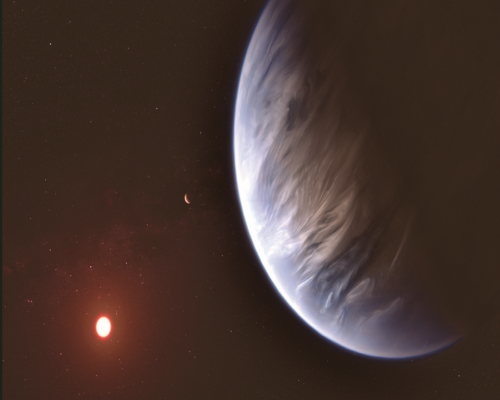
In a remarkable astronomical breakthrough, researchers from NASA and the European Space Agency (ESA) have identified a distant exoplanet that is believed to be rich in water. The planet, classified as a “Super-Earth,” is orbiting within the habitable zone of its parent star, raising the possibility that it could support life.
The planet, designated TOI-1846d, is located 1.792 times the size of Earth and completes one revolution around its star in just 3.93 days. Despite its close proximity to its sun-like star, scientists suggest that the planet’s unique atmospheric conditions and potential abundance of water could make it a candidate for future habitability studies.
The discovery was made using the Transiting Exoplanet Survey Satellite (TESS) and confirmed through advanced spectroscopic analysis. According to the research team, the planet’s density and orbital characteristics indicate a high probability of water presence, either in the form of vast oceans or as water-rich ice layers beneath its surface.
Astronomers emphasize that TOI-1846d’s classification as a “Super-Earth” is based on its size and composition, which falls between Earth-like rocky planets and larger gaseous planets. This finding not only contributes to the growing list of potentially habitable worlds but also advances our understanding of planetary formation and the distribution of water in the universe.
Further studies are planned using next-generation telescopes to analyze the planet’s atmosphere, search for biosignatures, and confirm the extent of its water reserves. Scientists believe this discovery could bring humanity one step closer to answering the age-old question of whether life exists beyond Earth.