
The Exam That Could Not Stand: Inside the NEET Paper Leak and India’s Fight to Restore Trust in Competitive Exams
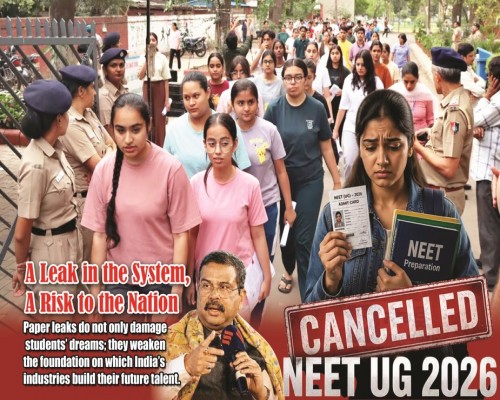
For millions of Indian families, NEET is not just an examination. It is a national aspiration compressed into one afternoon. It is the dream of becoming a doctor, the hope of social mobility, the result of years of coaching, sacrifices, loans, hostel stays, family expectations and personal discipline. That is why any allegation of a NEET paper leak does not remain merely an administrative controversy. It becomes a national trust crisis.
The latest controversy relates to NEET-UG 2026, conducted on 3 May 2026 by the National Testing Agency, or NTA. The exam was held in pen-and-paper mode from 2:00 PM to 5:00 PM IST, across 551 cities in India and 14 cities abroad, at more than 5,432 centres, with approximately 22.79 lakh registered candidates. NTA had claimed large-scale arrangements involving city coordinators, observers, centre superintendents, invigilators, district administrations, police and escort teams, with over two lakh personnel mobilised for the exam.
Yet within days, the exam became the centre of a major paper leak controversy. On 12 May 2026, NTA announced the cancellation of NEET-UG 2026 after serious allegations of question paper leakage and irregularities. According to reports citing the NTA statement, the decision was taken after inputs from central and law enforcement agencies indicated that the examination process “could not be allowed to stand.” The matter was handed over to the Central Bureau of Investigation, and NTA announced that a re-examination would be conducted without fresh registration or additional fee.
This cover story examines what happened, how the alleged leak took place, how the government responded, what NTA is doing, and what this episode means for the future of public examinations in India.
The Day of the Exam: A National Exercise Under Pressure
NEET-UG is among India’s most sensitive examinations because it determines admission to undergraduate medical courses. The scale itself is enormous. More than twenty-two lakh students preparing for a limited number of medical seats makes the examination not only competitive but emotionally charged.
Before the 2026 examination, NTA issued detailed public communication claiming that arrangements were in place for smooth conduct. The examination was to be held in offline pen-and-paper mode. Candidates with disabilities were given additional time, and the agency highlighted the deployment of city coordinators, observers, centre staff and security support.
However, the post-exam events showed that administrative scale alone is not enough. In a high-stakes exam, the integrity of the question paper chain is everything. If the paper is compromised even before the exam, the physical security at thousands of centres becomes secondary. The central question becomes: who had access, when did the leak occur, and how far did the compromised material travel?
From Allegations to Cancellation
Initially, the controversy began with allegations and reports of a possible leak. But it escalated rapidly. On 12 May 2026, NTA cancelled the NEET-UG 2026 examination held on 3 May. The agency said the decision was taken after inputs from central and law enforcement agencies indicated serious irregularities. Around 22 lakh candidates had appeared in the examination.
This was a significant moment. In 2024, when NEET-UG was also hit by allegations of paper leak and irregularities, the Supreme Court had refused to cancel the entire examination because it found no material to show that the leak had vitiated the whole examination at a systemic level. In 2026, however, the official response was different. The exam was cancelled early, and the CBI investigation was ordered.
The difference appears to lie in the seriousness and nature of investigative inputs. NTA’s decision, as reported, was that the present examination process could not be allowed to stand. This language indicates that the authorities considered the irregularities serious enough to affect the credibility of the entire examination process, not merely isolated malpractice.
How the Leak Allegedly Happened
The most important details came from the CBI investigation. According to an official release from the Ministry of Personnel, Public Grievances and Pensions, the CBI arrested an alleged kingpin and source connected with the leak. The investigation revealed that P.V. Kulkarni, a Chemistry lecturer involved in the examination process on behalf of NTA, allegedly had access to the question papers.
The CBI alleged that during the last week of April 2026, before the NEET-UG exam, Kulkarni mobilised students with the help of Manisha Waghmare and conducted special coaching classes at his residence in Pune. According to the CBI, he dictated questions, options and correct answers, and the handwritten questions recovered from students exactly tallied with the actual NEET-UG 2026 question paper held on 3 May 2026.
This detail is crucial because it indicates that the alleged leak was not merely a rumour or post-exam speculation. The CBI claimed that material recovered from students matched the actual examination paper. That gives the investigation a documentary trail: handwritten notes, student statements, digital devices, communication records and possible money transactions.
The CBI registered the case on 12 May 2026on the basis of a written complaint from the Higher Education Department of the Ministry of Education. By 14 May 2026, seven accused persons had been arrested from locations including Jaipur, Gurugram, Nashik, Pune and Ahilyanagar. The agency said it had identified the source of the Chemistry paper leak as well as middlemen who allegedly mobilised students after collecting several lakh rupees.
The investigation later widened. By 27 May 2026, official broadcaster News On Air reported that the CBI had arrested two more persons, including a Latur-based doctor and a physics faculty member at a Pune coaching institute, taking the total number of arrests to thirteen. The CBI also conducted searches at 49 locations and seized documents, laptops and mobile phones.
The emerging picture is disturbing. It suggests a possible network involving insiders, coaching links, intermediaries, students and money. In such cases, the paper leak is not just an act of one corrupt individual. It becomes a marketplace of unfair advantage.
The Shadow of NEET 2024
The 2026 controversy cannot be understood without recalling the 2024 NEET-UG crisis. NEET-UG 2024 was held on 5 May 2024. According to the Supreme Court’s judgment, the examination involved 23,33,297 candidates, 4,750 centres, 571 cities in India, and 14 overseas cities, competing for approximately 1.08 lakh undergraduate medical seats.
In 2024 too, petitioners alleged paper leak, irregularities, malpractices and systemic deficiencies. FIRs from states including Delhi, Gujarat, Rajasthan, Jharkhand, Maharashtra and Bihar were transferred to the CBI. The Supreme Court accepted that there was no dispute about leaks at Hazaribagh and Patna, but it refused to cancel the entire examination because it did not find sufficient material to show a systemic breach across the whole exam.
The Court observed that a retest would have serious consequences, including disruption of the admission schedule and impact on candidates, particularly those from marginalised backgrounds. It therefore held that cancellation of the entire exam was not justified on the material available at that stage.
However, the Court also emphasised the need to strengthen the system. The Union Government constituted a seven-member expert committee chaired by former ISRO Chairman Dr. K. Radhakrishnan to examine reforms in the examination process, data security protocols and NTA’s functioning.
That is why the 2026 controversy has attracted sharper scrutiny. If reforms were recommended after the 2024 crisis, why did another major NEET leak allegation arise in 2026? This is the question now being asked by students, parents, courts and the public.
Government Response: Law, Investigation and Reform
The government response to paper leaks has moved on three tracks: criminal law, investigation and institutional reform.
First, India now has a specific central law: the Public Examinations (Prevention of Unfair Means) Act, 2024. The Act came into force on 21 June 2024. It treats leakage of question papers, collusion, unauthorised possession of question papers or OMR sheets, providing solutions, tampering with OMR sheets, violating examination norms, tampering with computer networks, fake websites and fake examinations as unfair means.
The Act makes offences cognizable, non-bailable and non-compoundable. It provides punishment for individuals, service providers, senior management and organised crime networks. For organised crime, the punishment can extend from five to ten years, along with a minimum fine of one crore rupees. The law also allows investigation by senior police officers and referral to a central investigating agency.
This law is important because paper leaks are no longer viewed as ordinary cheating. They are treated as organised attacks on public trust. The statement of objects and reasons of the Act recognises that malpractices in public examinations cause delays, cancellations and serious harm to millions of youth.
Second, the government handed the NEET-UG 2026 matter to the CBI. The CBI investigation has led to multiple arrests and searches, and official releases indicate that the agency is investigating both the source of the leak and the network of middlemen and beneficiaries.
Third, the government and NTA have moved toward administrative reforms. After the 2024 controversy, the Ministry of Education had constituted the High-Level Committee of Experts headed by Dr. K. Radhakrishnan to review the exam process, improve data security protocols and recommend changes in NTA’s structure and functioning.
In 2026, the Supreme Court again questioned the preparedness of NTA. In a petition filed after the latest NEET controversy, the Court issued notice and asked NTA to file an affidavit on steps taken to implement the High-Level Committee’s recommendations. The Court also asked about the status of the monitoring mechanism created after the earlier controversy.
NTA’s Handling of the Situation
NTA’s handling of the situation has had two sides: immediate crisis management and long-term institutional reform.
On the immediate side, NTA cancelled the 3 May 2026 examination, announced a re-examination and clarified that candidates would not need fresh registration or payment of additional fee. Its public notices also referred to refund of examination fee, re-examination, FAQs and provisional answer keys relating to NEET-UG 2026.
The re-examination was scheduled for 21 June 2026, from 2:00 PM to 5:15 PM IST, in pen-and-paper mode. NTA said it would be conducted in 13 languages, including Hindi, English, Assamese, Bengali, Gujarati, Kannada, Malayalam, Marathi, Odia, Punjabi, Tamil, Telugu and Urdu. Candidates were also given a window to update city and preferred address details.
NTA’s FAQs clarified that there would be no additional fee for the re-examination, the medium of examination could not be changed, the centre might not necessarily remain the same, and grievances could be raised through the NTA helpdesk.
These steps were necessary, but they do not remove the stress faced by students. For a NEET aspirant, preparing once for the final exam is exhausting. Preparing again after cancellation is emotionally and mentally draining. Many students come from modest backgrounds. Some live away from home. Some had already begun planning counselling, travel or next steps. For them, the cancellation may be administratively justified but personally painful.
On the reform side, NTA issued a public statement on 19 May 2026 saying it was strengthening its leadership and institutional framework. It referred to reforms under the High-Level Expert Committee’s recommendations and said structural, technological and human-resource reforms were being undertaken to rebuild the integrity architecture of public examinations.
NTA said four senior government officers had been posted to strengthen the organisation, including two Joint Secretary-level officers as Additional Director Generals, in line with the Radhakrishnan Committee’s recommendations. It also advertised specialist leadership positions, including Chief Technology Officer, Chief Financial Officer and General Manager-HR.
The proposed Chief Technology Officer’s role is particularly important. NTA said the CTO would work on an end-to-end digital examination ecosystem, candidate-facing systems, confidential question-paper management, AI-driven integrity controls, impersonation detection, biometric and face authentication, anomaly analytics, cybersecurity and coordination with institutions such as NIC, C-DAC, CERT-In and MeitY.
In its affidavit before the Supreme Court, NTA reportedly stated that it had introduced major security and structural reforms after the leak, including mandatory CCTV checks, 90-day footage retention, mock drills, weather contingency plans, power backups, emergency medical facilities and post-exam forensic analysis of CCTV footage.
NTA also informed the Court that reforms recommended by the High-Level Committee were either implemented or in final stages, and that state-level and district-level coordination committees were operational before the May 3 examination.
Will Computer-Based Testing Solve the Problem?
One of the major reform questions is whether NEET-UG should move from pen-and-paper mode to computer-based testing. NTA told the Supreme Court that it is preparing to conduct NEET-UG in computer-based test mode from 2027. Digital testing is seen as a way to reduce risks connected with printing, physical storage and transportation of question papers. It can also allow encrypted delivery, real-time monitoring and better audit trails.
However, computer-based testing is not a magic solution. India’s NEET candidate base is large and diverse. Students come from metro cities, small towns, rural areas and remote districts. Any shift to CBT must ensure that rural candidates and candidates from weaker digital infrastructure areas are not disadvantaged. Availability of secure computer centres, power backup, network reliability, language support and accessibility for persons with disabilities will be critical.
The challenge is therefore not simply “offline versus online.” The real challenge is secure design. A paper-based exam can be secure if printing, packaging, transportation and custody are foolproof. A computer-based exam can also be compromised if cybersecurity, access control, server integrity or impersonation checks are weak. The future system must combine technology with accountability.
The Accountability Question
The Supreme Court has also raised concerns over accountability. In the 2026 proceedings, the Court reportedly questioned NTA’s functioning and asked for clarity on institutional memory, specialised personnel and implementation of reforms. The government informed the Court that the Prime Minister was personally supervising the process for the reconduct of the examination, while the Court emphasised that actual accountability must be fixed.
This is a central issue. India cannot treat every paper leak as an isolated accident. When a leak occurs, four levels of responsibility must be examined.
First, individual criminal liability must be fixed against those who leaked, sold, bought or used the paper. Second, administrative responsibility must be fixed against those who failed to secure the examination chain. Third, institutional responsibility must be fixed if processes were weak, outdated or ignored. Fourth, policy responsibility must be fixed if the examination model itself has become too vulnerable for its scale.
Without accountability, reform becomes a press release. With accountability, reform becomes a deterrent.
What Needs to Change
The NEET paper leak controversy shows that India needs a new examination integrity architecture. This architecture must include secure question paper generation, controlled access, encrypted transmission, strict personnel vetting, surveillance, digital audit trails, independent monitoring, real-time incident reporting and strict prosecution.
For paper-based exams, question papers must be protected from the point of setting to printing, packaging, transportation, storage, opening and distribution. Every handover must be documented. Every access point must be logged. Every person in the chain must be accountable.
For digital exams, cybersecurity must be at the centre. Encryption, server isolation, endpoint security, biometric authentication, AI-based anomaly detection and independent technical audits must become mandatory.
The coaching ecosystem also needs attention. Coaching institutes are not inherently problematic; many provide genuine academic support. But where coaching networks become channels for leaked papers, impersonation or unfair access, enforcement must be strict. The investigation into the 2026 case suggests that the alleged network may have involved teachers, coaching links and intermediaries.
Student protection is equally important. Honest candidates must not become victims twice — first of the leak, and then of administrative uncertainty. Whenever an examination is cancelled, authorities must communicate quickly, clearly and compassionately. Re-exam dates, centres, admit cards, refunds, grievance systems and counselling schedules must be handled with sensitivity.
A Crisis Beyond One Exam
The NEET leak controversy is not merely about medical admissions. It is about the credibility of India’s competitive examination system. Public examinations are one of the few instruments through which a student from an ordinary family can compete with a student from privilege. If that system is compromised, the injury is not only educational; it is constitutional and moral.
A paper leak tells honest students that merit can be purchased. It tells parents that sacrifice may be defeated by corruption. It tells society that public opportunity is vulnerable to private manipulation.
That is why the government’s response must be both strict and transparent. Arrests are necessary, but not enough. Laws are necessary, but not enough. Reforms are necessary, but not enough. The system must demonstrate that it can prevent, detect, respond and punish.
NTA, too, stands at a turning point. It was created to bring standardisation and efficiency to national-level testing. But repeated controversies have affected public confidence. Its future credibility will depend not on statements, but on performance: secure exams, timely communication, transparent grievance redressal and visible accountability.
The Real Re-Examination
The re-examination of NEET-UG 2026 is not only for students. It is also a re-examination of India’s examination institutions.
Students will again sit with pens, admit cards and dreams. But the larger test will be for NTA, the government, law enforcement agencies and the examination security architecture. Can they prove that merit is protected? Can they ensure that no student with money or connections gets an unfair advantage? Can they restore confidence among parents and aspirants?
The NEET paper leak controversy has exposed the fragility of a system on which millions depend. But it has also created an opportunity. If India uses this crisis to build a stronger, technology-enabled, accountable and student-sensitive examination system, then the damage may lead to reform.
For now, one message must be clear: in a country where education is the pathway to dignity, no examination paper should be allowed to become a commodity. The future of India’s youth cannot be leaked, sold or negotiated. It must be protected with the seriousness of a national trust.