
The Runway to a New India: How Jewar Is Redrawing the Economic Map of North India
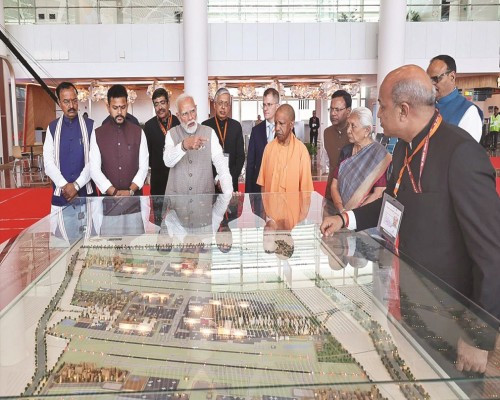
There are certain infrastructure projects that do more than connect places. They connect eras. They signal the beginning of a new economic geography, a new confidence, and a new imagination of what a region can become. The Noida International Airport at Jewar is one such project. It is not merely an airport. It is a declaration of intent. It is the visible arrival of a development model in which connectivity, commerce, industry, logistics, urban expansion, and aspiration converge into one strategic vision. For western Uttar Pradesh, for the National Capital Region, and for India’s evolving growth story, Jewar represents far more than the opening of a transport hub — it represents the creation of a new growth engine.
For decades, the idea of a world-class international airport in western Uttar Pradesh existed more as a promise than a reality. It appeared in policy discussions, regional development plans, investment dreams, and political speeches. It was often spoken of as a transformative necessity for a fast-growing region that remained overly dependent on Delhi’s aviation infrastructure. Yet for years, the project remained trapped between ambition and execution. Today, that dream has not only materialised — it has begun to redefine the economic future of North India.
With the inauguration and operational launch of the first phase of the Noida International Airport in Jewar, India has effectively added a new strategic aviation gateway to the NCR. But more importantly, it has activated one of the most consequential infrastructure-led economic opportunities in the region’s modern history. This is not just an airport for passengers. It is a platform for industry, a magnet for investment, a logistics backbone, an employment creator, a tourism catalyst, and a trigger for urban transformation. It is the kind of project that changes not only how people travel, but how regions grow.
A Project Bigger Than Aviation
The true significance of Noida International Airport begins with the recognition that this project was never meant to be just another airport. It has been conceived as a strategic economic ecosystem — a gateway that is expected to influence trade, manufacturing, real estate, warehousing, exports, services, tourism, and regional planning for decades to come. In a country where major infrastructure is increasingly being viewed as the foundation of economic competitiveness, Jewar stands out as one of the most future-facing projects of its kind.
India’s aviation sector has been growing rapidly. Rising incomes, business expansion, increased domestic mobility, tourism growth, and regional air connectivity have transformed aviation from a luxury-driven segment into an increasingly broad-based economic necessity. Delhi’s Indira Gandhi International Airport has long shouldered much of North India’s aviation demand. But as traffic volumes increased and economic activity intensified across the NCR and adjoining states, the need for a second major international airport became not just desirable, but structurally important.
Jewar emerged as the answer to that challenge — but not in the form of a backup facility. Instead, it has been designed as a full-scale, world-class airport with independent economic significance. That distinction matters. This is not overflow infrastructure. This is flagship infrastructure.
A Strategic Location with Regional Power
Located in Gautam Buddha Nagar district in Uttar Pradesh and positioned along the Yamuna Expressway, the airport occupies one of the most strategically significant locations in North India. It lies close enough to the NCR to serve as a major alternate aviation gateway for millions of passengers, yet far enough from the saturated urban core of Delhi to allow large-scale expansion and planned economic development around it.
This geographical balance is precisely what gives Jewar its extraordinary long-term value. It is not just accessible; it is expandable. It is not just functional; it is strategically placed within a larger development corridor. The airport is expected to benefit not only Noida, Greater Noida, and Ghaziabad, but also districts such as Bulandshahr, Aligarh, Agra, Mathura, Meerut, and even adjoining areas of Rajasthan and Haryana. In practical terms, this means the airport has the potential to serve an enormous catchment population and a very large economic zone.
That is why Noida International Airport is not merely a district-level or state-level project. It is a regional infrastructure pivot.
The Runway as an Economic Engine
The economic value of a major airport lies not only in the aircraft it handles, but in the economic energy it unleashes around itself. This is where Jewar becomes especially important. Airports of this scale are not passive assets; they actively reshape land use, investment behaviour, trade patterns, and business geography.
A modern airport attracts logistics companies, cargo operators, hospitality chains, real estate developers, exporters, warehouses, conference spaces, commercial offices, retail services, and ancillary businesses. It creates a surrounding ecosystem of opportunity. This is particularly relevant for western Uttar Pradesh, which already possesses industrial and commercial strength but has historically lacked aviation-linked logistics depth of the kind that can unlock higher-order economic activity.
Jewar is expected to help correct that imbalance.
For businesses, proximity to a modern international airport reduces friction. It improves executive mobility, strengthens trade efficiency, supports faster supply chains, lowers uncertainty, and enhances investor confidence. In today’s economy, infrastructure is not merely support — it is strategy. And in that sense, Jewar is a strategic asset for North India’s future.
Why Industry Will Benefit the Most
Among the biggest beneficiaries of the airport are likely to be the industrial and manufacturing ecosystems of the region. Districts like Ghaziabad, Noida, Greater Noida, and adjoining industrial belts are already home to a wide range of manufacturing units, exporters, engineering firms, electronics companies, logistics businesses, and service providers. Yet one of the hidden barriers to greater competitiveness has always been logistics and transport inefficiency.
That is where Jewar can become transformative.
The airport is expected to improve access to domestic and international markets, particularly for businesses operating in sectors where time-sensitive delivery and connectivity matter. Industrialists know that competitiveness today depends not only on production capacity, but on the speed and reliability with which goods, people, and decisions can move. An airport closer to production centres changes business calculations in very real ways.
The reports repeatedly highlight that the airport will give “wings” to regional industry — and this is not merely metaphorical. Better aviation and cargo infrastructure can make regional manufacturing more globally connected, more investment-friendly, and more agile.
A Cargo and Logistics Revolution in the Making
If passenger aviation is the visible face of the airport, cargo is likely to become its economic spine.
The first phase of the airport includes a Multi-Modal Cargo Hub with an Integrated Cargo Terminal, designed to handle a substantial volume of freight and logistics movement. This is crucial because in modern economies, the movement of goods is often more economically significant than the movement of people. The airport’s cargo vision has the potential to strengthen exports, high-value manufacturing, perishables logistics, electronics movement, pharmaceuticals distribution, machinery dispatch, and e-commerce infrastructure.
This is especially significant for businesses in western Uttar Pradesh and the wider NCR who have long needed a more efficient cargo and freight ecosystem outside Delhi. A strong airport cargo backbone can reduce delivery time, improve export readiness, increase warehousing demand, attract distribution centres, and create an entirely new layer of business activity around the airport.
In many ways, Jewar’s cargo potential may prove just as important as its passenger traffic.
A 25-Year Dream Finally Takes Off
One of the most fascinating dimensions of the airport is the sheer length and complexity of its journey. The airport did not emerge overnight. It is the result of a 25-year policy, political, regulatory, and administrative process — one that reflects both the difficulty and importance of large-scale infrastructure development in India.
The airport’s story dates back to 2001, when the idea of an international airport in the region was first proposed under the leadership of then Chief Minister Rajnath Singh. The objective was clear: to strengthen the economy of western Uttar Pradesh through major connectivity infrastructure. But as with many ambitious projects in India, the path ahead proved far from simple.
In 2010, the proposal gained renewed attention during the tenure of then Chief Minister Mayawati, when efforts were made to secure necessary approvals, including from the Defence Ministry. In 2012, however, the project reportedly faced rejection at the central level due to concerns related to the distance of the proposed site from Delhi’s existing airport.
Yet the dream refused to die.
In 2013, under Chief Minister Akhilesh Yadav, the Jewar airport proposal was revived again, supported by the argument that the site offered sufficient strategic separation and future value. After further delays and uncertainty, the project began to gather serious momentum again from 2015 onward, particularly through state-level policy backing and planning support.
From there, the timeline accelerated:
- June 2017 – Site-related permissions and state cabinet approval
- January 2018 – Social Impact Assessment and acquisition-related processes begin
- August 2018 – In-principle approval from the Civil Aviation Ministry
- 2019 – Land acquisition awards, compensation processes, and possession proceedings
- November 2019 – Tender process and developer selection
- October 2020 – Agreement finalisation
- 25 November 2021 – Foundation stone laid by Prime Minister Narendra Modi
- 9 December 2024 – First aircraft landing reported on the runway
- March 2026 – Security clearance and aerodrome licence for flight operations
This timeline reveals an essential truth: infrastructure at this scale is not a single event. It is a long institutional journey involving vision, persistence, negotiation, land, approvals, contracts, engineering, and certification. Jewar’s story is therefore also the story of how India builds.
The Human Story Behind Development
No great infrastructure project is built in abstraction. It is always built on land, through negotiation, and often through significant social transition. The Noida International Airport is no exception.
The project required the acquisition of large tracts of land across multiple villages, and this process deeply affected thousands of farming families. Reports indicate that the first phase alone involved approximately 1,334 hectares of land, with around 7,000 farmers affected across phases. Villages such as Rohi, Ranhera, Kishorepur, Banwariwas, Dayanatpur, Parohi, Junedpur, Kureb, and Karauli Bangar are among those linked to the transformation.
Compensation worth thousands of crores was reportedly distributed to affected landowners, and for many families, this created both opportunity and uncertainty. Some benefited financially and entered a new economic phase. Others faced the emotional and social disruption that comes when agricultural identity gives way to industrial and urban transition.
This is an important part of the Jewar story. Development creates momentum, but it also demands adaptation. The airport is therefore not only an engineering achievement — it is also a human transition zone, where rural landscapes are being reshaped into an urban-economic future.
From Farmland to Aerotropolis
One of the most compelling concepts associated with the airport is the idea of Jewar as an aerotropolis.
An aerotropolis is not simply an airport with surrounding development. It is an airport-centred urban and economic region, where the airport acts as the nucleus of commercial, residential, logistics, hospitality, and business activity. It is a model seen in some of the world’s most dynamic airport-driven growth zones.
Jewar is being increasingly discussed in precisely these terms.
This matters because it means the airport is not merely serving an existing city — it is helping create a new urban growth centre. The surrounding land is expected to attract hotels, logistics hubs, offices, industrial parks, convention spaces, warehouses, and modern residential development. If executed with planning discipline, the region around the airport could become one of North India’s most significant new economic urban zones.
This is where the project shifts from being transport infrastructure to becoming city-shaping infrastructure.
A Multi-Modal Gateway Built for the Future
The long-term success of any airport depends not just on what happens inside the terminal, but on how seamlessly it connects with the outside world. Jewar’s planners appear to understand this well.
The airport has been envisioned as a multi-modal transport hub, integrated with a broader ecosystem of expressways, metro, rail, rapid rail, and road networks. Its direct access to the Yamuna Expressway already gives it a major strategic advantage. Planned future linkages with metro and rail networks are expected to make it even more accessible across the region.
This is critical because the real value of an airport is not only determined by runway length or passenger terminal design. It is determined by how quickly and easily people, goods, workers, and businesses can reach it.
A highly connected airport becomes an economically powerful airport.
Designed for Scale and Long-Term Growth
One of the strongest indicators of Jewar’s seriousness is its phased growth model.
The first phase of the airport has been designed for an annual passenger capacity of around 12 million passengers, but future expansion plans aim to increase this to 30 million, 50 million, and eventually 70 million passengers annually. That level of planning reflects long-term ambition rather than short-term utility.
The airport’s first phase includes a 3,900-metre runway, capable of handling large aircraft, and a modern passenger terminal built with future expansion in mind. The infrastructure has not been conceived as a limited regional facility. It has been built to scale into one of India’s major aviation platforms.
That distinction is essential. Jewar is not simply being opened. It is being grown into significance.
Modern, Smart and Sustainability-Oriented
The airport has also been positioned as a modern, technologically advanced, and environmentally conscious aviation facility. It is expected to feature smart systems, digital passenger experience design, efficient operations, and sustainability-linked planning principles.
In an era where infrastructure is judged not only by scale but by intelligence, efficiency, and environmental sensitivity, this matters greatly. Airports today are no longer merely transport terminals; they are operational ecosystems. Energy efficiency, passenger flow management, digital integration, sustainability measures, and future-readiness all determine how globally relevant such infrastructure becomes.
Jewar’s vision suggests that India is no longer simply building bigger airports — it is trying to build smarter airports.
A Strategic Relief for Delhi-NCR
From a regional planning perspective, the airport’s opening is a major structural development for the Delhi-NCR. For years, Delhi’s aviation system has shouldered the overwhelming burden of northern India’s passenger and cargo demand. That concentration was never going to remain sustainable indefinitely.
Jewar changes the regional equation.
As the second major international airport for the NCR, it creates redundancy, resilience, and capacity expansion within the region’s aviation network. It offers a more convenient option for millions who would otherwise have had to depend solely on Delhi. It also gives airlines, cargo operators, and businesses a new operational choice.
This kind of redistribution matters enormously. Infrastructure becomes truly strategic when it reduces overdependence on a single node and opens up multiple pathways for growth.
Taking Air Travel Closer to the People
Another important dimension of the airport is the way it symbolically and practically brings air travel closer to a broader population base.
For many residents of western Uttar Pradesh, access to aviation infrastructure has long meant dealing with the congestion, travel time, unpredictability, and distance associated with reaching Delhi. The new airport changes that equation. It makes air connectivity more geographically accessible to a large and economically significant population.
This is not only about convenience. It is about inclusion in a new mobility economy. As airports move closer to more people, air travel becomes less exceptional and more integrated into everyday business and social life. Students, professionals, traders, families, exporters, and small business owners all stand to benefit.
Tourism, Hospitality and New Circuits of Growth
The airport’s location also gives it the potential to become a major boost for tourism and hospitality. Better air access can significantly improve travel to multiple destinations in western Uttar Pradesh and adjoining regions, creating stronger possibilities for hotels, travel operators, pilgrimage circuits, heritage routes, and regional tourism development.
Airports are not only gateways to cities — they are gateways to economic circulation. When people arrive, spending arrives with them. Over time, the airport is likely to support a larger hospitality and tourism ecosystem around itself and beyond.
The Confidence Effect
Perhaps one of the most underappreciated effects of infrastructure is the confidence it creates.
Large projects like Jewar change how regions are perceived — by investors, by entrepreneurs, by institutions, by developers, and by the people who live there. They change planning psychology. They shift expectations. They tell the world that a region is no longer waiting for growth to come to it — it is preparing to host it.
This may ultimately be one of Jewar’s biggest contributions. It changes the mental map of North India.
Challenges, Responsibility and the Road Ahead
Of course, the opening of an airport is not the same as the completion of its story. The real test begins after inauguration.
The airport’s long-term success will depend on several factors:
operational excellence, airline adoption, route expansion, cargo performance, last-mile connectivity, supporting infrastructure, planned urban development, workforce skilling, and institutional coordination.
There will also be challenges. Airport-led development can become speculative if not properly governed. Real estate growth can become chaotic if not carefully sequenced. Local communities must be meaningfully included in the benefits of long-term economic change. Employment generation must be broad-based and durable.
In short, Jewar now needs not only admiration — it needs intelligent follow-through.