
Changing Social Perception Towards Treated Water is Imperative
India is facing a growing imbalance between water availability and demand, making it essential to rethink how treated water is perceived and utilized. The per capita availability of water in the country has been steadily declining. In 2021, it stood at approximately 1,486 cubic meters, which is projected to fall to 1,367 cubic meters by 2031. This is significantly below the estimated requirement of 1,700 cubic meters per person. Such a trend underscores the urgency of adopting sustainable water management practices.
Out of the country’s major river basins, a significant number are already under stress. Rapid urbanization, industrial expansion, and agricultural demand have intensified pressure on water resources. In urban areas, while infrastructure for water supply and sewage management has improved, inefficiencies persist. A large portion of water supplied to cities is lost due to leakage and poor maintenance, and nearly 39 percent of water is wasted. Additionally, the cost of maintaining and operating water infrastructure continues to rise, creating financial challenges for urban local bodies.
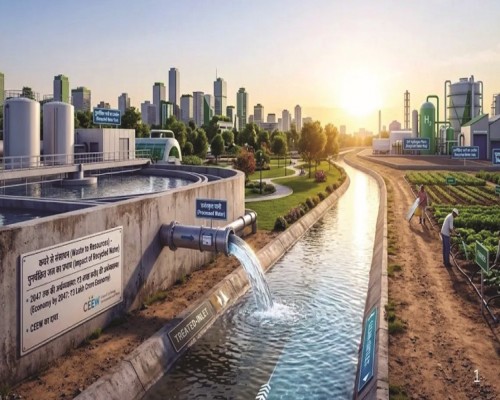
A major concern lies in the treatment and reuse of wastewater. Studies indicate that urban India generates approximately 72,200 crore liters of wastewater daily, but only about 2,700 crore liters are treated and reused. This highlights a massive gap in wastewater management. According to a report by the Council on Energy, Environment and Water (2023), if treated water is effectively used for irrigation, it has the potential to irrigate 13.8 lakh hectares of land. This could also result in savings of approximately ₹96,600 crore in irrigation costs while reducing dependence on freshwater sources.
Policy-level efforts have been made to address this issue. The National Water Policy emphasizes the reuse of treated water, and initiatives have been undertaken to promote its adoption. However, implementation remains inconsistent across states and urban bodies. Despite the presence of sewage treatment plants, much of the treated water is not reused and is instead discharged, leading to wastage.
The core challenge is not just infrastructural but also social. There exists a psychological and cultural resistance to using treated water, even when it meets quality standards. Overcoming this hesitation requires awareness campaigns, stakeholder engagement, and transparent monitoring systems. Public perception needs to shift from viewing treated water as waste to recognizing it as a valuable resource.
Treated water can play a crucial role in various sectors, including agriculture, industry, and urban landscaping. In agriculture, it can supplement irrigation needs, reducing the burden on freshwater sources. In industries, it can be used for cooling, processing, and other non-potable purposes. Urban applications include gardening, construction, and maintenance activities.
One promising area for the use of treated water is in data centers, which require substantial amounts of water for cooling. With the rapid expansion of digital infrastructure, water demand from data centers is increasing significantly. Estimates suggest that data centers in India may require up to 2.60 billion liters of water daily in the coming years. Utilizing treated water for such purposes can help conserve potable water and ensure sustainable operations.
Looking ahead, the integration of treated water into mainstream usage is not just an environmental necessity but an economic opportunity. It can reduce costs, improve water security, and support sustainable development. However, achieving this requires a coordinated approach involving government policies, technological advancements, and, most importantly, a shift in societal mindset.
Transforming the perception of treated water from a liability to an asset will be a decisive step toward addressing India’s water challenges and ensuring long-term sustainability.